

Tennessee Veterans Benefits: How the State’s Programs for Disabled Veterans Actually Work
Tennessee provides benefits and services to the 440,791 veterans living in the state through more than twenty separate agencies, each with its own eligibility criteria and application process. The Tennessee Comptroller’s Office of Research and Education Accountability reported in March 2026 that the state does not produce a comprehensive guide to those benefits, and recommended that the Department of Veterans Services create one. This article describes the programs as the administering agencies themselves describe them.
The sections that follow outline Tennessee’s property tax relief program for disabled veterans, the state veterans homes, state education grants for veterans and eligible dependents, employment preference in state government, and the tax provisions administered by the Department of Revenue.
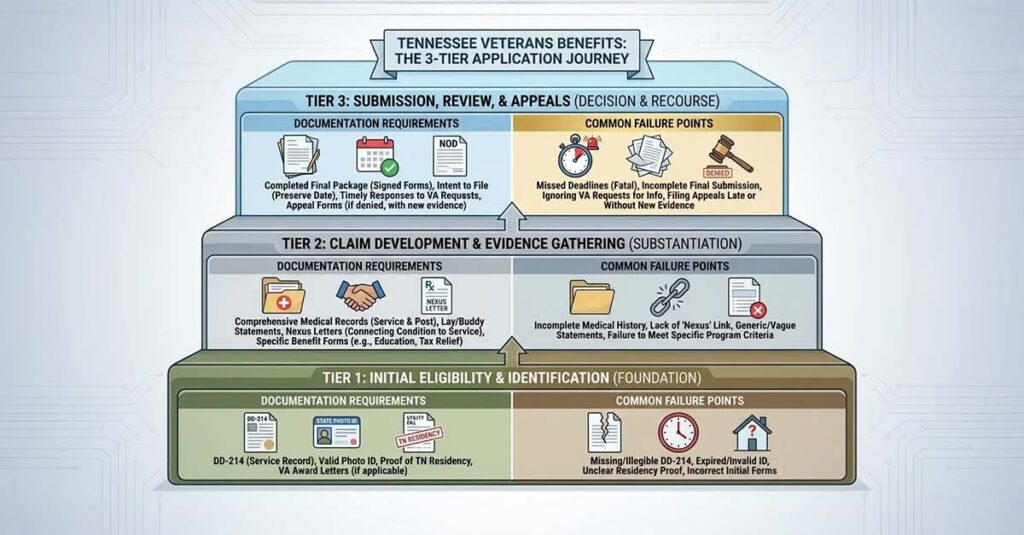
Documentation Requirements Across Tennessee Programs
Tennessee’s Property Tax Relief Program serves over 100,000 individuals each year. In fiscal year 2023-24, 25,882 disabled veterans and 4,643 surviving spouses received reimbursements under the program. Tennessee agencies do not publish approval-rate statistics for veterans benefit applications, and no state source characterizes documentation quality as a driver of program outcomes.
A DD-214 records service. It is not, by itself, the disability proof the property tax relief program uses. According to the Tennessee Comptroller of the Treasury, an applicant in the disabled veteran category must own the home and use it as a primary residence, and must complete Form F-16, a consent form releasing disability and income information from the U.S. Department of Veterans Affairs. Acceptable proof of residency includes a valid ID, an SSA letter, a VA letter, a voter registration card, or a bank statement. Requirements are set separately by each administering agency and are not standardized across programs.
How Property Tax Relief Applications Are Reviewed
Under Tenn. Code Ann. § 67-5-701, an application is submitted to the local collecting official on a form approved by the State Board of Equalization. The collecting official makes a preliminary determination of eligibility and forwards the application to the state for final approval. For the disabled veteran category, the statute provides that the VA’s determination concerning a veteran’s disability status is conclusive — the state does not make an independent medical finding. According to the Comptroller, a decision may be appealed within 90 days of the date on the initial unapproved or void letter, through the State Board of Equalization.
Application Deadlines
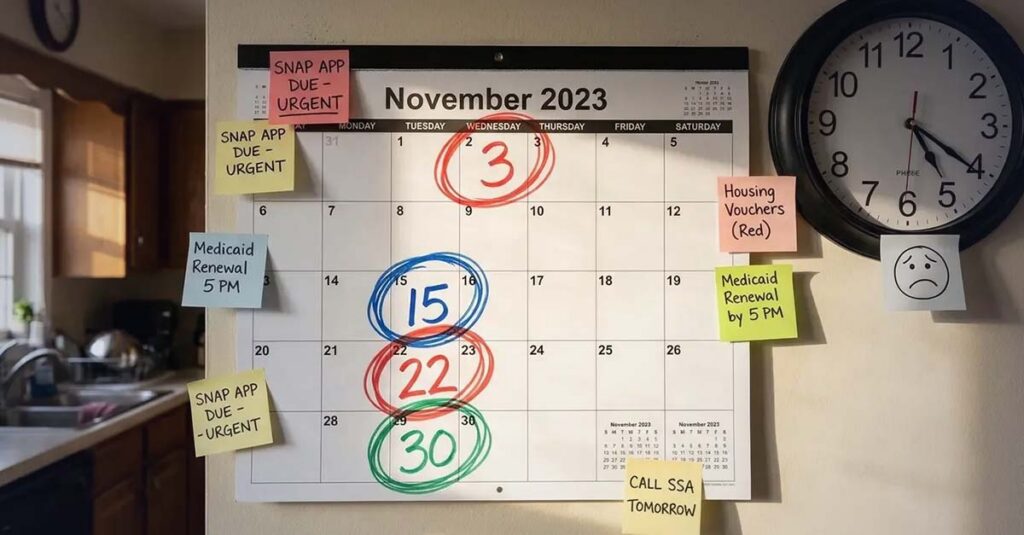
Different Tennessee programs run on different cycles. For property tax relief, Tenn. Code Ann. § 67-5-701(e)(3) provides that if annual appropriations are insufficient, the Comptroller applies a factor to uniformly adjust individual payments so that all timely claims can be paid within the appropriation. There is no first-come funding race in that program. An application made more than 35 days after the delinquency date in the jurisdiction results in ineligibility for that tax year. The program’s annual appropriation is $41,265,100.
Education deadlines run on the academic calendar rather than ahead of it. The Helping Heroes Grant has application processing deadlines of September 1 for fall, March 1 for spring, and May 1 for summer enrollment.
Tennessee’s Layered Benefits System: State vs. Federal Complexity
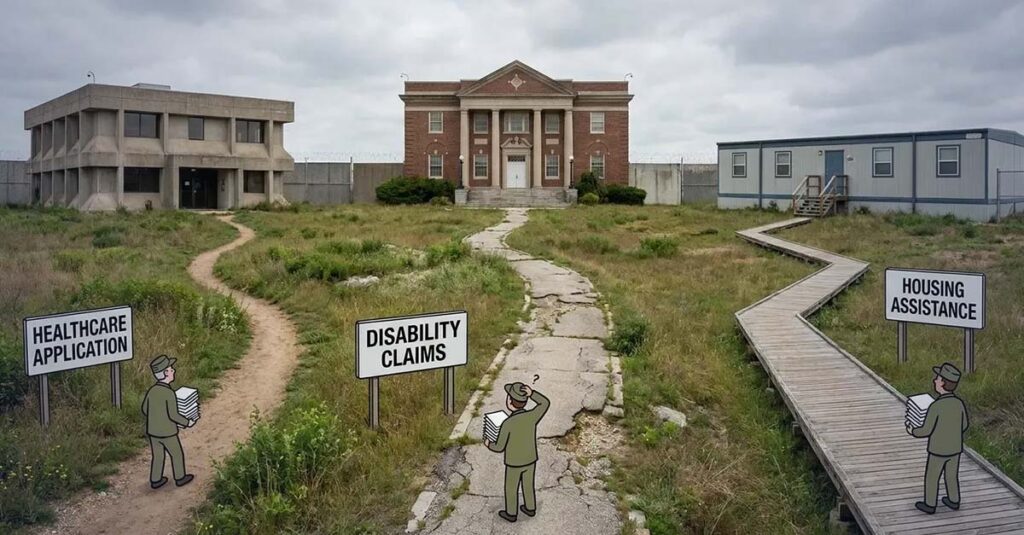
Federal veterans benefits — VA health care, disability compensation, the GI Bill — receive the majority of public attention. Tennessee’s state-level benefits operate in parallel, with different eligibility rules, application procedures and funding sources that do not automatically coordinate with federal benefit status. The Comptroller describes those benefits as spread across multiple state government agencies, with eligibility varying program by program.
Eligibility rules differ sharply even within a single program. The disabled veteran category of Tennessee’s property tax relief program carries no income limit at all, while the low-income elderly and low-income disabled categories are limited to applicants with 2025 income of $38,470 or less for the 2026 tax year.
Federal enrollment does not translate into state eligibility. Admission to a Tennessee State Veterans’ Home is open to honorably discharged veterans, spouses of veterans, and Gold Star Parents. TennCare, Tennessee’s Medicaid program, is administered separately and offers TennCare Medicaid and TennCare Standard without a veteran-specific eligibility category.
Where Tennessee Programs Are Administered
Property tax relief applications are received by county trustees and city collecting officials, but eligibility is determined by the Comptroller’s Tax Relief section. The Department of Veterans Services operates the state veterans cemeteries and field offices and serves as liaison for the state veterans homes, while the homes themselves are run by the Tennessee State Veterans’ Homes Board. The Helping Heroes Grant is administered through the Tennessee Higher Education Commission and the Tennessee Student Assistance Corporation. Veteran employment services run through the Department of Labor and Workforce Development’s Jobs for Veterans State Grants program.
Each of these programs maintains its own forms and processing systems, and a determination by one agency does not carry over to another. One approval does not predict outcomes for other applications, and one denial does not disqualify a veteran from other programs — with the exception noted below, where the property tax relief categories are mutually exclusive by statute.
At the county level, 148 County Veteran Service Officers serve 93 of Tennessee’s 95 counties, under Tenn. Code Ann. § 58-3-109. According to the Comptroller, these officers work with veterans on claims for health care, compensation, pension, survivor and burial benefits, and on military records requests, alongside the Department of Veterans Services’ network of 12 state veterans services field offices.
Property Tax Relief for Disabled Veterans
Tennessee’s Property Tax Relief Program includes a category specifically for disabled veterans and their surviving spouses. In fiscal year 2023-24 that category accounted for 66 percent of the program’s budget, or about $27.2 million. Tennessee does not publish an estimate of the eligible-but-unenrolled population, so no participation-gap figure can be stated.
The categories within the program are mutually exclusive. Relief under the disabled veteran provision is paid in lieu of any payment under the elderly or disabled-homeowner provisions, and only one recipient may receive relief for a given property per taxing jurisdiction in a tax year.
Disability-Based Property Tax Relief
Tennessee does not exempt disabled veterans from property taxes. The Comptroller of the Treasury states that tax relief is not an exemption: recipients still receive their tax bills and remain responsible for paying their property taxes each year, and the state then reimburses part or all of what was paid.
Under Tenn. Code Ann. § 67-5-704, the reimbursement is calculated on the first $175,000 of the property’s full market value. The statute sets the effective assessed value at 25 percent of that capped market value, then applies a tax rate adjusted for the jurisdiction’s appraisal-to-market ratio as determined by the State Board of Equalization. Because the calculation depends on local assessment and tax rates, the amount varies by jurisdiction and by year. Across veterans and surviving spouses in fiscal year 2023-24, the average reimbursement was $892.56.
The Comptroller confirms there is no income limit for the disabled veteran and surviving spouse categories.
The statute recognizes three eligibility categories. A veteran qualifies who acquired in connection with service a disability from paraplegia or permanent paralysis of both legs and the lower body from traumatic injury or disease to the spinal cord or brain, legal blindness, or loss or loss of use of two or more limbs from any service-connected cause; who acquired 100 percent permanent total disability as determined by the VA resulting from having served as a prisoner of war; or who acquired a service-connected permanent and total disability as determined by the VA. Veterans dishonorably discharged are excluded. The statute further provides that the VA’s determination concerning disability status is conclusive for purposes of the program.
Neither the statute nor the Comptroller’s published materials reference Individual Unemployability. Eligibility under the third category turns on whether the VA has determined a service-connected permanent and total disability.
Because the reimbursement is computed from the local tax rate and the property’s assessed value up to the statutory cap, two veterans in different Tennessee counties with the same disability status can receive different amounts.
Relief continues while a qualifying veteran is temporarily relocated for health care to the home of a friend or relative, or to a hospital or skilled or intermediate care facility, where the veteran indicates an intent to return to the residence.
A separate Department of Revenue benefit provides a disabled veteran license plate to veterans with loss or permanent loss of use of one or both feet or hands, permanent vision impairment in both eyes, or a 100 percent permanent and total service-connected disability under Tenn. Code Ann. § 55-4-256. A disabled veteran who chooses a standard plate instead may receive a free disabled driver decal, which provides access to accessible parking and is available to all qualifying disabled drivers rather than to veterans alone.
Tennessee’s program relies on the VA’s own disability determination rather than on a state review. Background on how the VA structures its ratings is available in REE Medical’s overview of understanding VA disability ratings.
Surviving Spouses
Relief extends to the surviving spouse of a disabled veteran who was eligible at the time of death, provided the spouse does not remarry, solely or jointly owns the property, and uses it exclusively as a home. The statute also extends relief to the surviving spouse of a veteran whose death resulted from a service-connected, combat-related cause, and to the surviving spouse of a soldier whose death resulted from being deployed away from a home base of training in support of combat or peace operations. Where a later amendment to the law would have made the deceased veteran eligible, relief is extended to the surviving spouse on that basis as well. Applications in this category use Form F-16S together with the veteran’s death certificate and personal identification. In fiscal year 2023-24, 4,643 surviving spouses received approximately $4.1 million.
Age-Based Property Tax Relief
Tennessee’s low-income elderly category is open to any homeowner who is 65 on or before December 31 of the tax year, owns and occupies the home as a primary residence, and reports annual income from all sources at or below the limit. For the 2026 tax year that limit is $38,470 in 2025 income for the applicant, spouse, co-owner and resident remainder, with relief calculated on a maximum market value of $33,600. There is no partial or graduated relief tier based on income: an applicant is either within the limit or not eligible. This category is not a veterans benefit, and a veteran who qualifies under the disabled veteran provision receives that relief in lieu of the elderly category.
The Comptroller requires annual income from all sources for these categories and lists a VA letter among the accepted proofs of income. The Tennessee Attorney General has stated that “annual income from all sources” includes veterans’ benefits under Title 38.
Two related provisions sit alongside the state program. Counties and municipalities may adopt supplemental tax relief on top of the state program under Tenn. Code Ann. § 67-5-701(j), capped so that combined relief does not exceed the total tax due. A separate local-option property tax freeze under Tenn. Code Ann. § 67-5-705 is available in some jurisdictions for homeowners 65 and older, with income limits that vary by county.
Annual Renewal
Relief is renewed annually. According to the Comptroller, an approved recipient a property tax relief voucher with the property tax bill each year and presents it to the collecting official before the deadline along with payment of any balance due. A voucher not presented within 35 days of the delinquency date results in ineligibility for that tax year, with no retroactive relief. There is no multi-year renewal variant.
Healthcare Access Beyond the VA: Tennessee-Specific Programs
VA health care is the most recognized health resource for veterans, and Tennessee separately operates or oversees programs that serve veterans through state channels. These are parallel systems with their own eligibility criteria, service offerings and application processes, and the Comptroller’s 2026 catalog is the authoritative list of state benefits and services for veterans in Tennessee.
Tennessee State Veterans Homes
The Tennessee State Veterans’ Homes Board operates five homes — in Humboldt, Clarksville, Murfreesboro, Cleveland and Knoxville — providing long-term care, skilled nursing and rehabilitative care. Together they have 636 beds, with an average daily census of 529 in August 2025; a sixth home in Arlington with 126 planned beds was in end-stage construction as of fall 2025. Eligible residents include honorably discharged veterans who meet residency criteria, spouses of veterans, and Gold Star Parents. The Board operates without regular state appropriations, drawing revenue from the VA, Medicaid, Medicare, private insurance and residents’ personal funds. No statewide waitlist policy is published by the Board or by the Department of Veterans Services.

TennCare
TennCare, Tennessee’s Medicaid program, offers TennCare Medicaid and TennCare Standard, applied for through TennCare Connect or any Department of Human Services office. The Comptroller’s 2026 catalog of state benefits for veterans no veteran-specific TennCare program; TennCare eligibility is determined on the program’s general criteria.
CoverRx
Tennessee’s prescription assistance program is CoverRx, administered under TennCare rather than the Department of Health. According to TennCare, CoverRx provides access to more than 200 generic medications plus some brand-name insulin, mental health medications and naloxone products, with no monthly premium. Eligibility is limited to individuals ages 18 to 64 with incomes at or below 138 percent of the federal poverty level who have no pharmacy coverage. There is no veteran eligibility category and no veteran priority.
Veterans Treatment Courts and State-Funded Counseling
Tennessee funds 12 veterans treatment courts, which served 173 veterans in fiscal year 2023-24 at a cost of $921,757.64, and a $700,000 annual grant to Centerstone Military Services for counseling related to post-traumatic stress disorder. Both are documented in the Comptroller’s 2026 report.
Education Benefits That Extend Past the GI Bill
GI Bill benefits are federal. Tennessee separately funds a grant for veterans and a statutory tuition waiver for certain survivors. The two programs rest on different eligibility bases, and the Comptroller catalogs both in its 2026 report on state benefits for veterans.
Dependent Tuition Waiver
Tennessee’s dependent education benefit is the Dependents’ Post-Secondary Education Tuition Waiver, authorized by Tenn. Code Ann. § 49-7-102. Eligibility is limited to the spouse or a dependent child under the age of 23 of a service member who was killed, died as a direct result of injuries received, or was officially reported as a prisoner of war or missing in action while serving during a qualifying period of armed conflict. The service member must have been a Tennessee resident at the time of death or at the time of entering service. It is not available to dependents of living veterans on the basis of a permanent and total disability rating. The waiver is also conditioned on the recipient not receiving comparable federal education benefits from another source. Applications are handled through the veterans services office of the Tennessee public institution the student attends.
Understanding the full range of benefits available to spouses and family dependents of disabled veterans gives families a fuller picture of the support that exists beyond the veteran’s own compensation.

Helping Heroes Grant
The Helping Heroes Grant is available to up to 375 eligible veterans each year on a first-come, first-served basis, funded from lottery proceeds. Award amounts are $1,000 per semester for 12 or more hours and $500 for 6 to 11 hours, for a maximum of eight full-time semesters. Applicants must be Tennessee residents without a baccalaureate degree who received the Iraq Campaign Medal, Afghanistan Campaign Medal, Global War on Terrorism Expeditionary Medal on or after September 11, 2001, or the Inherent Resolve Campaign Medal. Application deadlines are September 1, March 1 and May 1 for fall, spring and summer, and applications go to the Tennessee Student Assistance Corporation. In fiscal year 2024-25, 233 students received $345,500 under the grant.
Institutions Covered
Tennessee’s veteran and dependent education provisions apply at state public institutions, including the Tennessee Colleges of Applied Technology. Related statutory provisions catalogued by the Comptroller include in-state tuition treatment, tuition deferral, priority course registration and HOPE scholarship exemptions. Program approval status is published by each institution and by the administering agency. The Comptroller also records $308,506 in Veteran Reconnect grants in fiscal year 2023-24 supporting veteran services at Tennessee institutions.
Employment Provisions for Tennessee Veterans
Tennessee has state-level employment provisions for veterans that sit alongside federal USERRA rights. In state government hiring, the TEAM Act provides veterans preference in the appointment and promotion process. Tenn. Code Ann. § 50-1-107 authorizes — but does not require — a private employer to adopt a written veterans preference hiring policy. Tennessee imposes no veteran hiring or retention mandate on private employers, and there is no employer-size or sector tiering.
Hiring Preferences in Public Employment
Under the TEAM Act, eligible veterans applying for Tennessee state government positions receive preference in the interview process for appointments and promotions. This is an interview preference and a tie-breaker rather than a points-based system: where two candidates are equally qualified, hiring preference goes to the veteran. If a hiring supervisor selects another candidate over an eligible veteran who was interviewed, the supervisor must record the reasons in writing in a bypass letter, which is available to the veteran. Eligible veterans also receive 60 months of layoff credit. Department of Human Resources policy states that the preference is given under Tenn. Code Ann. § 8-30-307 to an applicant who meets the minimum qualifications and documents veteran status, and that a qualifying spouse or surviving spouse must also be invited to the first round of interview questions. The process uses a referred pool of candidates rather than examination scores.
The Department of Veterans Services publishes the eligibility conditions for TEAM Act preference, including the conditions under which an eligible spouse is guaranteed an interview.
Limitations on Hiring Preferences
Veterans preference operates within a position’s stated qualification requirements; minimum education, experience and skill requirements still apply. Under the TEAM Act, preference applies to both appointments and promotions, so promotional opportunities are not outside the preference structure.

Workplace Accommodation Rights
Workplace accommodation obligations arise under the federal Americans with Disabilities Act and, in Tennessee, under the Tennessee Disability Act. The Attorney General’s Civil Rights Enforcement Division investigates alleged violations of the Tennessee Human Rights Act and the Tennessee Disability Act. No Tennessee statute creates a veteran-specific workplace accommodation right.
Veterans moving into the civilian workforce may also find broader context in resources on how veterans can build rewarding careers after military service.
State Civil Rights Enforcement
The protected characteristics enumerated in the Tennessee Human Rights Act’s employment provision, Tenn. Code Ann. § 4-21-401, are race, creed, color, religion, sex, age and national origin; the Attorney General’s Civil Rights Enforcement Division lists the protected characteristics it enforces as race, color, creed, religion, sex, age, national origin, familial status and disability. Veteran status is not among them. Employment protections tied specifically to military service arise under federal law, principally USERRA. Complaints under the Tennessee Human Rights Act and the Tennessee Disability Act are now handled by that division rather than by a separate human rights commission.
Employment Services Through American Job Centers
The Department of Labor and Workforce Development places Disabled Veterans’ Outreach Program specialists and Local Veterans’ Employment Representatives in American Job Centers under the federal Jobs for Veterans State Grants program, supported by a U.S. Department of Labor award of $3,913,502 for 2026. Disabled veterans are a priority population for the outreach program’s services.
How Rating Levels Interact With Tennessee Programs
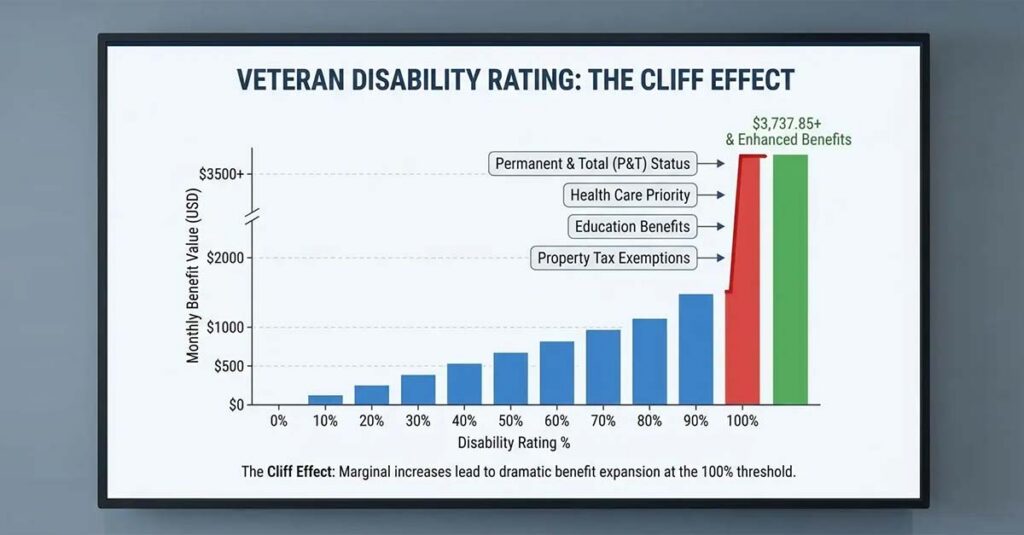
Tennessee’s disabled veteran property tax relief is not tied to a numeric rating percentage. Tenn. Code Ann. § 67-5-704 defines three qualifying categories: service-connected paraplegia or permanent paralysis of both legs and lower body from traumatic spinal cord or brain injury or disease, legal blindness, or loss or loss of use of two or more limbs from a service-connected cause; a VA determination of 100 percent permanent total disability resulting from having served as a prisoner of war; or a VA determination of service-connected permanent and total disability. The statute provides that the VA’s determination concerning a veteran’s disability status is conclusive.
Some Tennessee provisions do reference specific rating levels. The wheel tax exemption under Tenn. Code Ann. § 5-8-102(d)(1) applies to former prisoners of war and to veterans rated 100 percent permanently and totally disabled from a service-connected cause, and the reduced-fee hunting and fishing license is available to Tennessee residents who are 100 percent permanently and totally disabled from a service-connected cause or 30 percent or more disabled by reason of war service.
Medical Records and Functional Impact
Clinical records vary in how thoroughly they document the functional impact of a diagnosed condition as distinct from the diagnosis itself. Context on what evidence is needed for a disability claim describes the distinction between records that name a condition and records that describe its functional consequences.
Other Verified Tennessee Provisions for Disabled Veterans
The Comptroller’s 2026 catalog was compiled by contacting 48 state departments and agencies. It identifies no state utility-assistance or emergency-assistance program specific to veterans. Tennessee’s utility assistance is the federally funded Low-Income Home Energy Assistance Program, administered by the Tennessee Housing Development Agency on income criteria with no veteran category. The verified state provisions below are the ones the catalog does record.
Vehicle and Motor Vehicle Tax Provisions
According to the Department of Revenue’s tax manual for military members and veterans, a vehicle purchased with a VA Automobile Grant is exempt from sales and use tax, registration fees and local motor vehicle privilege taxes, effective March 5, 2018, and adaptive equipment for a disabled veteran’s vehicle is likewise exempt from sales and use tax. Of 156,069 military plates issued in fiscal year 2023-24, 59,576 were issued at no charge, 80.3 percent of them disabled veteran plates.

Business Tax Exemption
The Department of Revenue’s tax manual describes a business tax exemption for a disabled veteran who is a Tennessee citizen and resident of the county, whose business property does not exceed $5,000 and capital stock does not exceed $5,000, and who is the sole beneficiary of the business.
Hunting and Fishing Licenses
Tennessee residents who are 100 percent permanently and totally disabled from a service-connected cause, or 30 percent or more disabled by reason of war service, are eligible for a combined sport fishing and hunting license for a one-time $10 fee, according to the Department of Veterans Services.
Housing
The Tennessee Housing Development Agency offers Homeownership for Heroes, which reduces the interest rate on a THDA Great Choice mortgage by one-half of a percentage point for eligible veterans and active-duty service members. In fiscal year 2023-24 the program supported 306 loans totaling $80,341,360. This is a home-purchase program rather than emergency or eviction-prevention assistance.
State Veterans Cemeteries
Tennessee operates five state veterans cemeteries — Middle Tennessee in Nashville, two in Knoxville, West Tennessee in Memphis, and Parkers Crossroads. The Lyons View location in Knoxville is at capacity and does not accept pre-registration.
State Income Tax Treatment
Tennessee levies no general income tax on wages, and the Hall income tax on interest and dividends was repealed for tax years beginning January 1, 2021. The Department of Revenue’s tax manual for military members and veterans sets out the remaining state tax treatment that applies to veterans.
Additional Catalogued Provisions
The Comptroller’s report also records the Governor’s Veteran Fellows program at $738,000 for six fellowship positions, retirement system service credit for military service, and state park and handgun permit fee provisions for qualifying veterans.
REE Medical and the Medical Documentation Gap
Programs across these categories evaluate medical evidence against their own written standards, and those standards often turn on documented functional limitation rather than the presence of a diagnosis alone. Tennessee’s property tax relief program is a contrasting example: under Tenn. Code Ann. § 67-5-704, the VA’s disability determination is conclusive and the applicant completes a consent form rather than submitting medical records.
REE Medical coordinates access to independent, licensed healthcare professionals who complete VA Disability Benefits Questionnaires (DBQs) and objective medical evaluations. These are standardized medical documents the VA uses as part of its evaluation process. REE Medical’s providers are familiar with VA documentation formats and the evidence standards associated with different diagnostic codes and rating criteria.
REE Medical does not prepare, present, or submit VA disability claims and does not provide legal or representational services. The focus is on complete, objective, VA-compliant clinical documentation that accurately represents a veteran’s medical history and addresses functional limitation.
Veterans can learn more about coordinating independent medical evaluations by scheduling a complimentary consultation with REE Medical.
Final Thoughts
Tennessee veterans benefits exist across federal, state, county and institutional levels. Each of these programs is administered by a different body, under its own statute, with its own documentation requirements, and a determination in one does not carry into another.
The single most consequential correction to the common understanding of these programs is that Tennessee’s property tax benefit is a reimbursement rather than an exemption, calculated on market value up to $175,000 for the disabled veteran category, with an average payment of $892.56 across veterans and surviving spouses in fiscal year 2023-24. Context on the common challenges veterans face in VA disability advocacy describes the broader landscape these state programs sit within.
Tennessee’s programs are documented by the agencies that run them: the Department of Veterans Services, the Comptroller of the Treasury’s Tax Relief program, the Tennessee Student Assistance Corporation, the Department of Revenue, and county trustee and city collecting officials.
DISCLAIMER: REE Medical, LLC is not a Veterans Service Organization (VSO) or a law firm and is not affiliated with the U.S. Veterans Administration (“VA”). Results are not guaranteed, and REE Medical, LLC makes no promises. REE Medical’s staff does not provide medical advice or legal advice, and REE Medical is not a law firm. Any information discussed, such as, but not limited to, the likely chance of an increase or service connection, estimated benefit amounts, and potential new ratings, is solely based on past client generalizations and not specific to any one patient. The doctor has the right to reject and/or refuse to complete a Veteran’s Disability Benefit Questionnaire if they feel the Veteran is not being truthful. The Veteran’s Administration is the only agency that can make a determination regarding whether or not a Veteran will receive an increase in their service-connected disabilities or make a decision on whether or not a disability will be considered service-connected. This business is not sponsored by, or affiliated with, the United States Department of Veterans Affairs, any State Department of Military and Veterans Affairs, or any other federally chartered veterans service organization.