

Evidence-Based VA Claims Are Being Built on a Foundation Most Veterans Miss
VA disability claims are evaluated against a large body of medical research that the VA already consults internally, yet most claimants never see this research reflected in their own paperwork. Understanding how the VA’s evaluation process draws on medical literature, and how that shapes what counts as strong documentation, clarifies the evaluation process for veterans and their families rather than leaving it as a guessing game. This article explains how VA raters use research and clinical data, how independent medical documentation fits into that process, and how REE Medical coordinates access to licensed providers who complete objective evaluations.
Why Research-Informed Evidence Matters at the Rating Level
The VA employs medical professionals who evaluate claims using standardized criteria. These criteria were developed from decades of medical research, veteran health studies, and epidemiological data on service-related conditions. When medical documentation reflects the same research context that VA raters already reference internally, the record presented to the VA more closely mirrors the framework the VA itself uses.
The VA’s Office of Research and Development supports health research across more than 115 VA facilities and maintains internal resources that raters may consult when evaluating complex claims. Comprehensive medical documentation allows the VA to assess a veteran’s condition against this existing body of knowledge rather than relying solely on a single medical opinion.

How VA Evaluation Draws on Medical Literature
VA raters have access to internal guidance documents, condition-specific research, and clinical literature when reviewing claims. According to the VA, presumptive conditions under the PACT Act were established after research accumulated to a point where individual case-by-case proof of exposure was no longer required for specific groups of veterans. This illustrates the type and volume of evidence the VA has historically found persuasive.
| Documentation Type | Where the Research Originates |
| Personal medical records | Individual treatment history |
| Population-level exposure and health data | VA Office of Research and Development, Department of Defense deployment health studies |
| Condition-specific clinical criteria | Peer-reviewed medical literature |
| Presumptive condition standards | Statutory and regulatory determinations based on accumulated research (e.g., PACT Act) |
Population Health Research and Service Connection
The VA has funded extensive research tracking veteran health outcomes by service era, deployment location, and occupational specialty. Studies exist examining respiratory conditions and blast exposure effects among veterans who deployed to Iraq or Afghanistan, and separate occupational health research documents exposure patterns tied to specific military roles.
According to the VA, information related to toxic exposure and eligibility for expanded benefits is outlined in detail on the PACT Act overview page. The National Academies of Sciences, Engineering, and Medicine also publishes reviews of veteran health issues connected to specific exposures and service periods, and the Department of Defense maintains its own deployment health research. These sources reflect publicly available research rather than instructions for how a specific claim should be structured.

Secondary Conditions in the Medical Literature
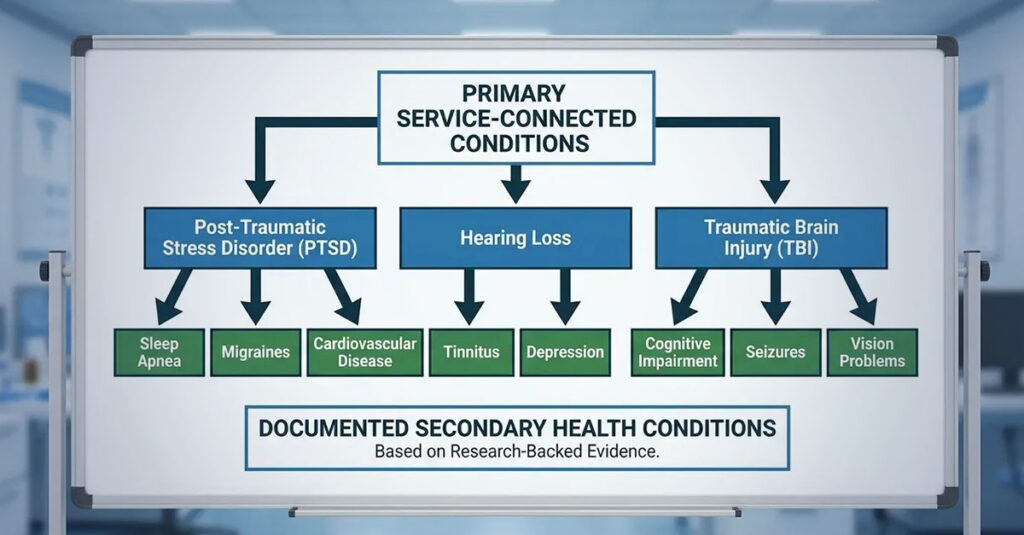
Secondary conditions are those caused or aggravated by an already service-connected condition. Medical literature documents well-established relationships between certain primary and secondary conditions — for example, chronic pain conditions are linked in published research to sleep disorders and mood-related conditions, and diabetes has documented associations with neuropathy, vision changes, and cardiovascular effects.
The VA’s own rating criteria for some conditions already reflect these documented relationships. Independent medical evaluations and Disability Benefits Questionnaires (DBQs) completed by licensed providers can reference relevant clinical research when describing how a primary condition relates to a secondary diagnosis, consistent with standard clinical practice.
Presumptive Conditions and VA Evidence Standards
Presumptive status is not granted without a substantial evidentiary basis. Agent Orange presumptive conditions, for instance, emerged after epidemiological studies tracking Vietnam-era veterans showed elevated rates of specific health conditions. The PACT Act similarly added numerous presumptive conditions tied to toxic exposure after research on burn pits and other hazards reached a threshold recognized in federal law.
Examining how presumptive status is established shows the type of population-level evidence the VA has accepted as reliable. This context clarifies how research-based documentation fits into the broader evaluation framework, without predicting or promising a specific outcome for any individual case.
DBQs and Their Basis in Clinical Research
Disability Benefits Questionnaires are standardized forms completed by licensed medical professionals to document a veteran’s current condition. Each question on a DBQ reflects clinical research about how a given condition typically presents and progresses. For example, musculoskeletal DBQs include range-of-motion measurements because orthopedic research has established specific thresholds correlated with functional limitation, and respiratory DBQs include specific pulmonary function values because that research is recognized as a reliable indicator of respiratory impairment.
REE Medical coordinates independent medical evaluations and DBQs completed by licensed healthcare professionals who are familiar with disability-focused documentation and VA-standardized forms.

When Individual Cases Differ From Typical Research Patterns
Medical research describes typical patterns, not universal rules. Individual presentations can differ — for example, published literature on delayed-onset PTSD documents cases where symptoms emerge years after a triggering event, even though many cases follow a more immediate timeline. Licensed medical providers routinely contextualize these variations when completing clinical documentation, referencing research on atypical presentations where relevant.
Distinguishing Current Diagnosis From Service Connection
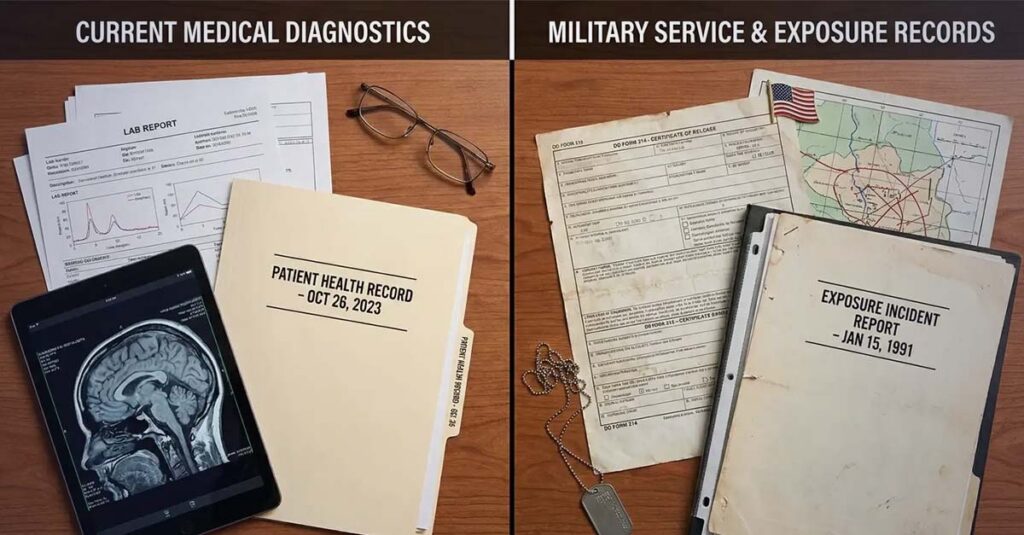
The VA evaluates two distinct elements in most claims: whether a veteran currently has a diagnosed condition, and whether that condition is connected to military service. Clinical literature on diagnostic criteria and symptom presentation supports the first element. Epidemiological and occupational research on causation, exposure, and disease latency supports the second. Comprehensive medical documentation, completed by a licensed provider, is designed to address both elements as part of a complete medical record submitted for VA review.
Exposure Research and Occupational Health Data
Military service records do not always capture every environmental or occupational exposure a veteran experienced. Exposure science and occupational health research — including studies maintained by the Agency for Toxic Substances and Disease Registry and the Department of Defense’s deployment health resources — document typical hazards associated with specific installations, deployment locations, and military occupational specialties. According to the VA, this type of population-based research contributed to the evidentiary basis for expanded presumptive conditions under the PACT Act.
REE Medical’s Role in Coordinating Independent Documentation
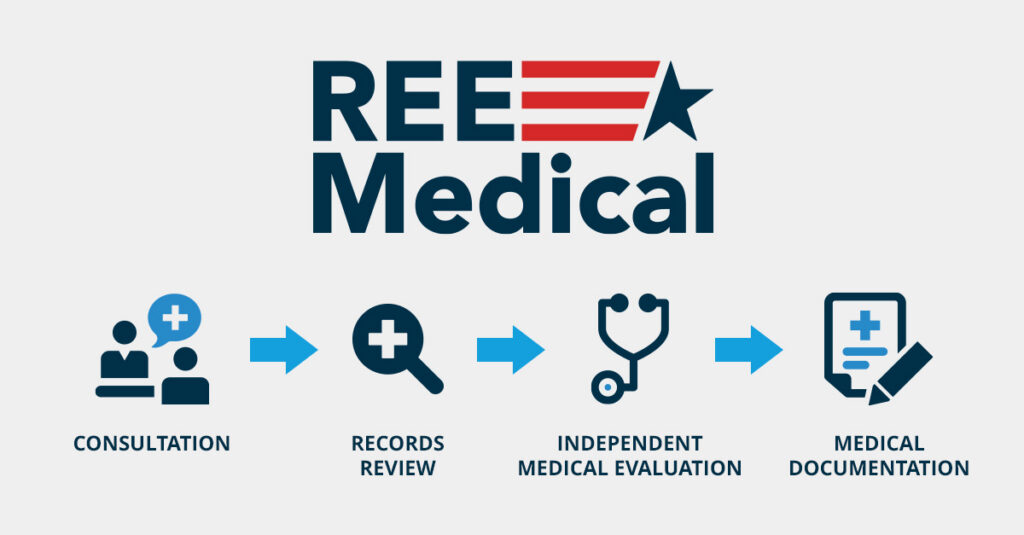
REE Medical coordinates independent medical evaluations and DBQs completed by licensed healthcare professionals who are familiar with disability-focused documentation and VA-standardized forms. REE Medical does not prepare, present, or submit VA disability claims and does not provide legal or representational services under 38 U.S.C. § 5901 or 38 U.S.C. § 5904.
Licensed providers coordinated through REE Medical reference relevant clinical and epidemiological research when completing objective medical documentation, in keeping with standard clinical practice. Veterans can learn more about coordinating VA-compliant independent medical evaluations and DBQs by contacting REE Medical for a complimentary, informational consultation.
Understanding the Research Behind the Documentation
The research the VA consults during claim evaluation is publicly accessible through sources such as the VA’s Office of Research and Development, the PACT Act performance dashboard, and the National Academies of Sciences. Medical documentation completed by licensed providers that reflects this same body of research gives the VA a fuller clinical picture to review. The VA remains the sole agency authorized to determine service connection or disability ratings, and outcomes depend on the specific facts and evidence in each individual case.
Disclosure
DISCLAIMER: REE Medical, LLC is not a Veterans Service Organization (VSO) or a law firm and is not affiliated with the U.S. Veterans Administration (“VA”). Results are not guaranteed, and REE Medical, LLC makes no promises. REE Medical’s staff does not provide medical advice or legal advice, and REE Medical is not a law firm. Any information discussed, such as, but not limited to, the likely chance of an increase or service connection, estimated benefit amounts, and potential new ratings, is solely based on past client generalizations and not specific to any one patient. The doctor has the right to reject and/or refuse to complete a Veteran’s Disability Benefit Questionnaire if they feel the Veteran is not being truthful. The Veteran’s Administration is the only agency that can make a determination regarding whether or not a Veteran will receive an increase in their service-connected disabilities or make a decision on whether or not a disability will be considered service-connected. This business is not sponsored by, or affiliated with, the United States Department of Veterans Affairs, any State Department of Military and Veterans Affairs, or any other federally chartered veterans service organization.