


VA Form 21-4142: What the VA Isn’t Telling You About Medical Records Authorizations
VA Form 21-4142 authorizes the VA to request private medical records on a veteran’s behalf — but the form’s function is widely misunderstood. Signing and submitting it grants permission; it does not guarantee retrieval. Between authorization and the actual placement of complete medical evidence in a rater’s hands sits a multi-party process with documented failure points that delay claims, exclude critical evidence, and contribute to denials that veterans later discover were based on incomplete records.
This article examines the mechanics of VA Form 21-4142 — the authorization window, what medical facilities actually do with records requests, which records the VA excludes even with a valid authorization, and how strategic timing affects what evidence reaches the decision maker. Understanding how this process works is foundational to understanding what evidence is needed for a disability claim and why documentation strategy matters at every stage.
Why VA Form 21-4142 Fails Veterans More Often Than It Succeeds
The Assumption That Authorization Equals Retrieval
VA Form 21-4142 gives the VA permission to request records. It does not compel medical facilities to respond, does not guarantee those responses will be complete, and does not ensure that records received by the VA will be correctly filed or reviewed. The authorization triggers a chain of events — each with its own failure points — that veterans rarely monitor because the form’s submission is assumed to have concluded their responsibility.
The VA sends records requests based on information the veteran provides on the form. When that information is incomplete, outdated, or imprecise, facilities either reject the request or route it to a department that has no record of the veteran ever being treated there.

To illustrate: a Marine Corps veteran filed for a back condition in March 2023 and submitted a 21-4142 listing “Springfield Orthopedic Center” as his treatment provider. Springfield had four locations across two counties, each with separate medical records departments. The VA sent the request to the main administrative office, which forwarded it to the wrong clinic location. That location had no record of the veteran. The request was marked “patient not found” and closed. The claim was decided eight months later without any of the veteran’s private orthopedic records. The failure was discovered only when the veteran requested his claims file after receiving a denial, finding a single-page response from the clinic stating they had no records for him.
These structural gaps are among the top reasons VA disability claims get denied — not because veterans are ineligible, but because evidence that exists never reaches the rater.
The Silent Expiration Problem
VA Form 21-4142 authorizations expire one year from the date of signature. The VA does not send reminders when an authorization is approaching expiration and does not notify veterans when an authorization lapses during an active claim. A claim in pending status may have had its authorization expire months prior, with no mechanism to alert the veteran that the VA can no longer legally request records. The claim continues to be processed on whatever evidence was already obtained, and the gap is not surfaced until a decision is issued.
Provider Non-Compliance Rates
Medical facilities ignore VA records requests at rates that are not widely publicized. Estimates suggest 30–40% of initial requests go unanswered, with facilities citing reasons that include never receiving the request, requiring authorization formats different from the standard VA form, demanding payment for records despite applicable federal regulations, or deprioritizing VA requests relative to other administrative workload. The VA’s follow-up on non-responsive facilities is inconsistent, and when follow-up does not produce records before the claim is rated, the decision proceeds on incomplete evidence.

The Authorization Window Nobody Explains (And Why It Matters)
One Year Is Insufficient for Many Claims
The average claim processing time for many veterans exceeds the one-year authorization window. A claim submitted in January 2024 with an authorization signed the same month expires in January 2025. If the claim is not assigned to a rater until March 2025, the VA will be unable to request additional records if needed — triggering a request to the veteran for a new form and adding weeks or months to the resolution timeline. For veterans in the appeals process, this cycle can repeat multiple times.
Ongoing Treatment Creates a Moving Target
Veterans who continue receiving treatment during the claims process face a specific gap: the records authorized at the time of initial submission do not include appointments, diagnoses, test results, or treatment plan updates that occur while the claim is pending. The VA does not automatically request updated records as treatment continues. The initial authorization captures a snapshot, and the claim is rated against that snapshot regardless of how much clinically relevant information accumulates afterward.
To illustrate the consequences: an Army veteran filed for PTSD in June 2023 and authorized the VA to request records from his private therapist covering treatment from January 2022 through June 2023. The claim took 11 months to process. During that period, the veteran continued weekly therapy. Those sessions documented significant symptom worsening, two crisis interventions, and a medication change indicating increased severity. When the claim was rated in May 2024, the decision was based entirely on records from 18 months prior. The rater had no access to the 40+ therapy sessions that occurred during the claims processing period. The veteran received a lower rating than his current treatment records would have supported, requiring a supplemental claim with a new 21-4142 and a request for a disability rating increase.
Supplemental Claims Require Fresh Authorizations
The VA treats each claim as a separate matter. An existing VA Form 21-4142 on file from a prior claim does not automatically apply to a supplemental claim. Veterans who file supplemental claims specifically to introduce new medical evidence and who assume prior authorizations cover the new filing will find that no records requests are generated for the supplemental claim until a new form is submitted.
What Medical Facilities Actually Do When They Receive Your 21-4142
The Records Department Bottleneck
Medical facilities route VA records requests to their health information management (HIM) departments. These departments process requests from multiple sources simultaneously: patients, insurance carriers, attorneys, other medical providers, and the VA. VA requests frequently receive lower priority than patient-initiated requests or court-ordered subpoenas. Some facilities process VA requests in batches once per month. Others require 30–60 days for routine requests.
Pre-Submission Provider Contact Checklist:
Verifying the following information for each medical facility before submitting VA Form 21-4142 prevents the most common retrieval failures:
- Exact legal name of the practice or hospital system
- Specific department name for medical records requests within large systems
- Direct phone number for the HIM or medical records department (not the main switchboard)
- Correct fax number monitored daily for records requests
- Mailing address specifically for records requests (distinct from patient billing address)
- Preferred method of receiving authorization forms (fax, mail, or patient portal)
- Average processing time the facility applies to VA records requests
- Any facility-specific authorization requirements beyond VA Form 21-4142
- Current status of the patient file (active, archived, or transferred)
- Any outstanding balance that may affect records release
Format Incompatibility
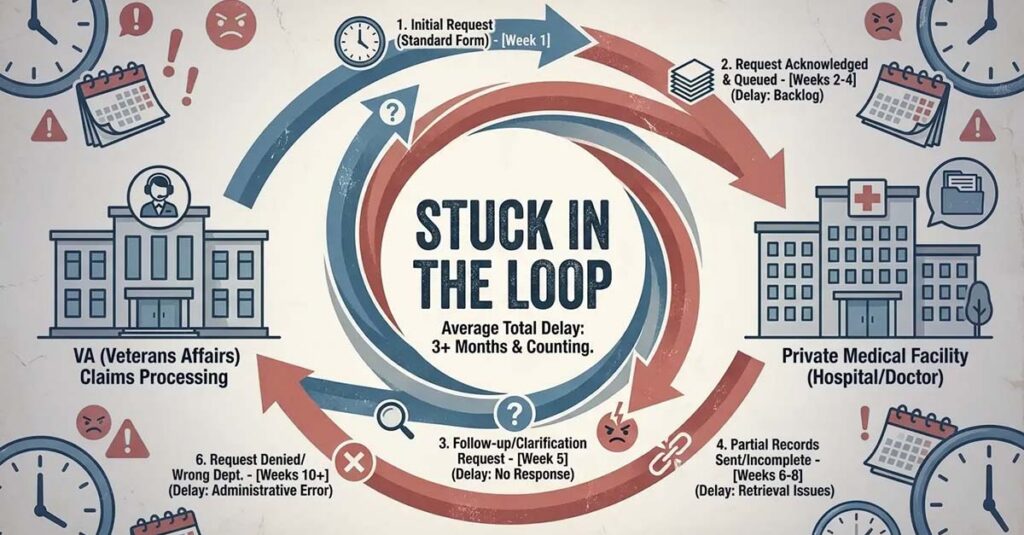
Many medical facilities maintain internal authorization forms and may determine that VA Form 21-4142 does not meet their requirements. Rather than processing the VA form, they send a request to the VA asking for their preferred authorization format. The VA does not always respond to these requests. The facility waits for its preferred form. The VA waits for the records. The claim sits while two separate bureaucratic systems are stalled over paperwork formatting, with no notification reaching the veteran.
The Partial Records Problem
Facility compliance does not guarantee completeness. Facilities frequently send visit summaries while excluding diagnostic test results; include progress notes while omitting imaging reports; or provide records from one provider within a multi-provider practice without including records from others at the same facility. The VA does not typically follow up to request missing components. The claim proceeds on whatever subset of records was received.
The Records the VA Won’t Request Even With a Signed Authorization
The Relevance Determination Filter
The VA does not retrieve all records covered by a veteran’s authorization. Claims processors make internal determinations about which records are relevant to the specific conditions claimed and request only those records. A veteran who authorized full access to their primary care physician’s records may find that only records related to the specific body system at issue were requested — while mental health treatment notes that could support a secondary condition, or cardiology records that contain service-connection evidence, were excluded as outside the claim’s scope.
Records Older Than the Default Retrieval Window
The VA’s default practice focuses on recent medical records. Historical records that establish onset timelines for progressive conditions are frequently excluded unless the veteran explicitly requests them by specifying date ranges on the form. A form that lists no date range is typically interpreted as a request for recent records only.
To illustrate: a Navy veteran filed for hearing loss in 2024. His private audiologist had documented progressive deterioration since 2015, with annual hearing tests showing measurable annual decline. This nine-year progression pattern directly supported the veteran’s claim. The veteran submitted a 21-4142 authorizing release of “all audiology records” without specifying date ranges. The VA requested only records from 2022 forward. Records from 2015–2021 — which contained the most compelling evidence of onset and progression — never reached the rater. The claim was denied for insufficient evidence of onset timeframe, requiring a supplemental claim with a new 21-4142 explicitly requesting “all audiology records from January 1, 2015 to present.”
Non-Traditional Treatment Providers
VA Form 21-4142 does not distinguish between provider types, but VA internal processes do. Records from chiropractors, physical therapists, pain management specialists, and other licensed healthcare providers who may have the most detailed documentation of a veteran’s functional limitations are frequently deprioritized relative to records from MD and DO providers. A veteran’s chiropractor may have years of notes that are directly relevant to a VA rating for back pain, but those notes may receive lower retrieval priority or be omitted entirely from the records request.

How to Audit Your Own Medical Records Request Before Submission
Complete Provider Information
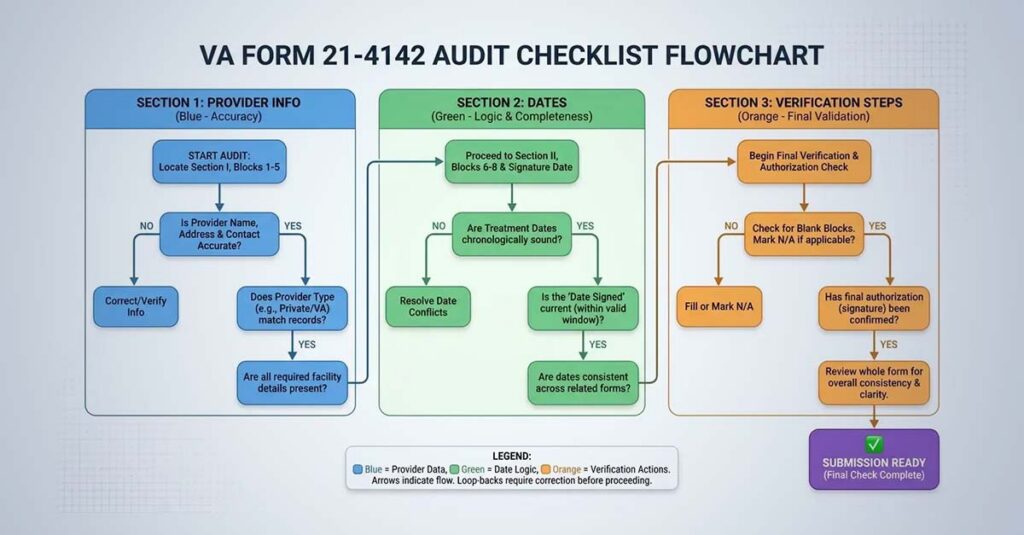
The form requires more than a provider name and city to function effectively. Needed information includes the exact legal name of the practice or facility; the specific department if it is a large hospital system; the current direct phone number for the medical records department; and the fax number that the facility actively monitors for records requests.
Confirming the facility’s preferred submission method for VA authorization forms — fax, mail, or patient portal — before submitting ensures the authorization reaches the correct department rather than a general administrative queue.
Date Range Precision
Specific date ranges should be entered in MM/DD/YYYY format. “January 15, 2020 to present” is more actionable than “2020 to present.” Separate treatment periods with the same provider should be listed as separate entries with distinct date ranges. Dates for specific tests, procedures, or hospitalizations should be noted explicitly when those records represent critical evidence.
VA Form 21-4142 Pre-Submission Verification Reference:
Provider Information:
- Full legal name of medical facility verified
- Specific clinic or department name included for multi-location facilities
- Complete street address including suite or building number
- Direct medical records department phone number obtained
- Medical records department fax number confirmed as currently monitored
- Provider’s National Provider Identifier (NPI) included if available
Treatment Dates:
- Start date of treatment specified in MM/DD/YYYY format
- End date specified, or “present” if treatment is ongoing
- Specific procedure or test dates listed separately if those records are critical evidence
- Multiple treatment periods with the same provider listed as separate entries
- Date ranges do not overlap with other 21-4142 forms already submitted for the same provider
Conditions and Purpose:
- Specific conditions or body systems clearly identified
- Language is consistent with the language used in the VA claim
- All relevant conditions listed, not only the primary claimed condition
- Specific tests or procedures referenced by name where applicable
Signature and Date:
- Form signed in ink if submitting a paper copy
- Signature date is current and within 30 days of submission
- Authorization will remain valid for at least six months from submission date
Pre-Submission Actions:
- Personal copies of all records obtained from the provider
- Provider confirmed to have current contact information on file
- Provider confirmed to accept VA Form 21-4142 without requiring a separate facility form
- Preferred submission method confirmed (fax, mail, or portal)
- Documentation of what records should exist retained for later verification
When Submitting Multiple 21-4142 Forms Backfires
Duplicate Request Confusion
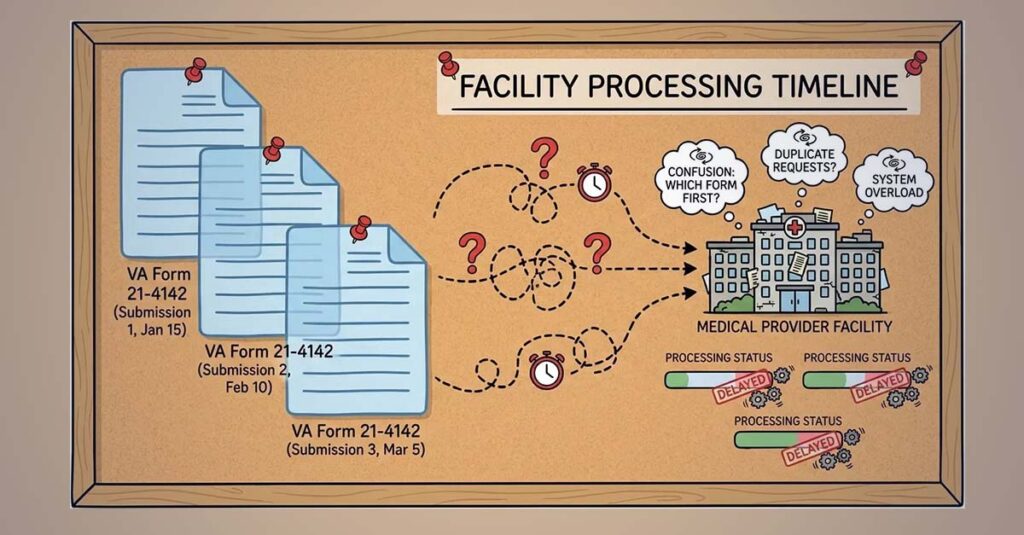
When multiple 21-4142 forms are submitted to the same medical facility over the course of multiple claims or appeals, the facility may receive several separate requests over an extended period. Records departments that recognize the pattern may flag requests as potential duplicates and process only one, under the assumption that earlier requests were already fulfilled. The most recent records — often the most relevant to the current filing — may never be sent because the facility concluded the earlier request was already sufficient.
Overlapping Date Ranges
Authorization forms with overlapping date ranges submitted at different times create administrative uncertainty at the receiving facility. The facility may send records in response to both requests, generating duplicate documents in the VA file that require manual reconciliation. Or the facility may process only one, treating the other as redundant. Either outcome introduces processing delays that are avoidable through clear date range management across successive submissions.
Provider Responsiveness Over Time
Medical facilities that receive multiple VA records requests for the same patient within a short period sometimes interpret the pattern as VA administrative disorganization or evidence that prior submissions were mishandled. This perception can reduce a facility’s responsiveness to future requests — a consequence that is significant when ongoing treatment means continued records requests will be necessary. Awareness of VA disability filing mistakes that stem from redundant submissions is an important part of managing the authorization process strategically.
The Digital Submission Trap That Creates Processing Delays
PDF Flattening
When VA Form 21-4142 is completed digitally, saved as a PDF, and submitted through certain VA portals, the form can be “flattened” during processing — converting completed fields from readable data into static image content. VA automated systems cannot extract information from flattened PDFs. These submissions are routed to manual processing queues, where staff must re-enter all information into VA systems. This adds a minimum of two to four weeks to processing time for what would otherwise be a routine digital intake.
File Size Limitations
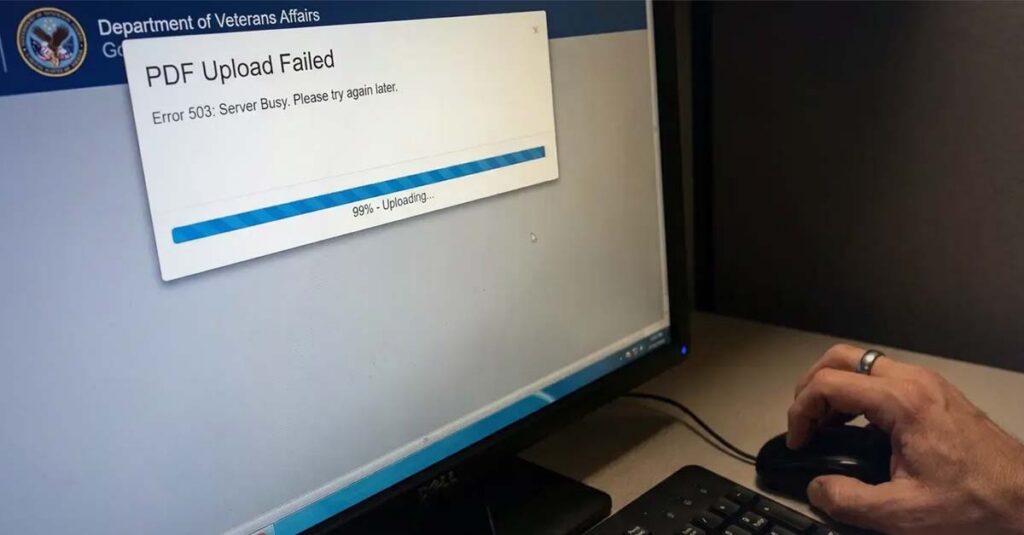
VA digital submission portals apply file size limits that are not always disclosed in advance. When VA Form 21-4142 is submitted as part of a larger document packet and the combined file size exceeds the portal’s threshold, the upload may fail silently — appearing to complete successfully on the submitting end while never being received. The claim then stalls waiting for an authorization that the veteran believes was already submitted.
Metadata Conflicts
Digital files carry metadata that records creation date, modification date, author, and software version. When this metadata does not align with expected parameters, VA systems may flag the submission for manual verification. The form is held in a verification queue until staff confirms it is legitimate, introducing delays for submissions that present no substantive issues.
Why Private Treatment Records Disappear Into the VA System
The Records Receipt Black Hole
When a medical facility sends records in response to a VA Form 21-4142 request, the VA receives and processes those records without generating any notification to the veteran. There is no confirmation, no claims status update, and no accessible log showing which providers have responded and which have not. Veterans who attempt to verify whether their records were received must either contact their regional office directly or request a copy of their claims file.
In some circumstances, veterans may be uncertain whether filing is possible at all; understanding whether a VA claim can be filed without medical records in certain situations can be relevant while working to resolve retrieval failures.
Misfiling Within the VA System
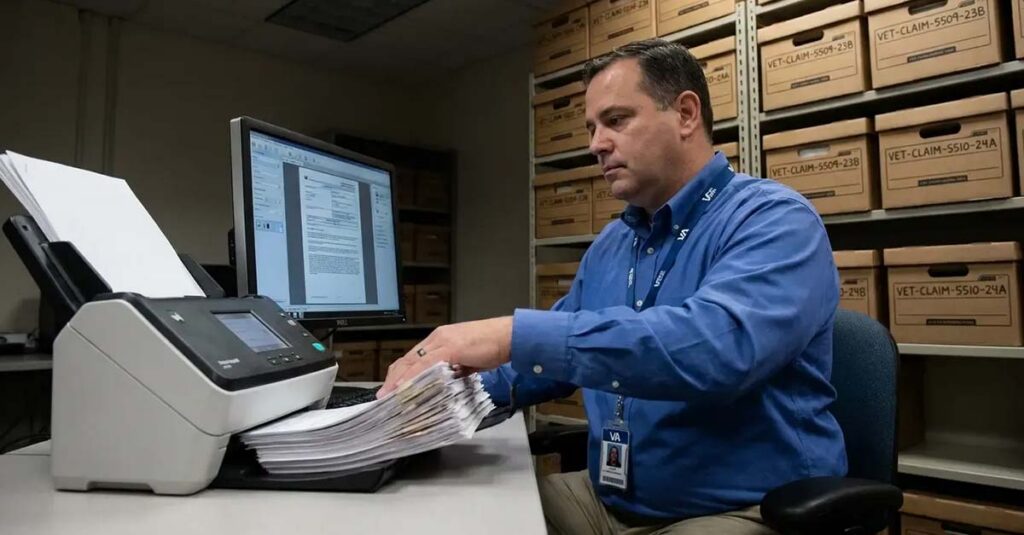
Records received by the VA are scanned and uploaded to electronic files by processing staff. Misfiling — associating records with the wrong claim, the wrong veteran, or the wrong section of a file — occurs in a system that processes millions of documents. A veteran’s orthopedic records may be filed under general correspondence rather than medical evidence. Records may be associated with a previous claim rather than the active one. The authorization functioned correctly, the facility responded, the records were received — but they are not accessible to the rater assigned to the claim.
Format Conversion Failures
Medical facilities send records in varied formats: faxed pages, mailed paper copies, electronic health record exports, and PDF files on physical media. The VA’s processing systems must convert each format into a standardized digital format. Conversion failures — faxed pages that become illegible after scanning, PDF files formatted for systems incompatible with VA software, or electronic health record exports using coding schemas the VA’s databases cannot read — result in records that were received but cannot be used. These records enter a technical problem queue while the claim proceeds without them.
Strategic Timing: When to Submit vs. When to Wait
Active Treatment and the Completeness Trade-Off
A veteran in active treatment for a claimed condition faces a timing consideration when submitting VA Form 21-4142. Submitting early ensures the VA has records on file, but those records will not include upcoming appointments, test results, or treatment plan updates that may strengthen the claim. Waiting until treatment reaches a natural conclusion or a significant milestone allows a single authorization to capture a more complete treatment arc — particularly relevant for conditions involving defined treatment courses such as physical therapy, mental health treatment plans, or pain management protocols.
When a claim has already been pending for several months, the priority shifts to getting updated records into the file before a rating decision is issued. A subsequent supplemental authorization can capture later treatment history.
C&P Exam Timing
When a Compensation and Pension (C&P) examination is scheduled, records submitted before the exam date are accessible to the examiner during the evaluation. Examiners who have reviewed a veteran’s private treatment history can address evaluation questions with fuller context — the treatments attempted, the responses documented, and the observations of other treating providers. Understanding the VA DBQ process and how examiner findings feed into rating decisions illustrates why having private records in the file before an examination affects the weight those records carry in the overall evaluation.
When authorizations are submitted after the examination, private records that arrive post-exam are treated as supplementary to the examiner’s findings rather than as context that informed them.
Appeals Timing
Veterans preparing an appeal should determine before filing whether new medical evidence will support the appeal or whether the argument rests on misinterpretation of existing evidence. When new evidence is needed, authorization for those records warrants submission 60–90 days before the appeal is filed. This allows time for the VA to retrieve the records before the appeal is assigned and processed. Appeals filed simultaneously with new authorizations frequently advance faster than the records retrieval process, resulting in an appeal decided without the new evidence the veteran intended to introduce.
REE Medical and the Medical Records Gap
VA Form 21-4142 initiates a records retrieval process that has multiple failure points — expired authorizations, facility non-compliance, partial responses, misfiling, and format conversion errors — none of which generate notifications to the veteran. The gap between authorization and verified, complete, correctly filed evidence is where claims stall and ratings are determined on incomplete records.
REE Medical coordinates access to independent, licensed healthcare professionals who complete VA Disability Benefits Questionnaires (DBQs) and objective medical evaluations. These are standardized medical documents the VA uses as part of its evaluation process. REE Medical’s providers are familiar with VA documentation formats and the evidence standards associated with different diagnostic codes and rating criteria.
REE Medical does not prepare, present, or submit VA disability claims and does not provide legal or representational services. The focus is on ensuring that a veteran’s medical history is clearly and accurately represented through complete, objective, VA-compliant clinical documentation — documentation that enters the claims file directly rather than through a multi-party retrieval chain with documented failure rates. Understanding VA disability ratings and the evidence standards that determine them begins with ensuring the medical record reflects what a veteran’s conditions actually involve.
Veterans can learn more about coordinating independent medical evaluations by scheduling a complimentary consultation with REE Medical.
Final Thoughts
VA Form 21-4142 is the beginning of a records retrieval process, not the conclusion of one. The authorization grants permission; retrieval, completeness, and correct filing are each subject to separate failure points that the VA does not proactively communicate to veterans. Expirations are silent. Non-responses from facilities are not flagged. Partial records are accepted without follow-up. Misfiled documents do not generate alerts.
Veterans whose claims are rated on incomplete evidence frequently discover the gap only after a decision letter identifies insufficient medical documentation. At that stage, the path forward requires a supplemental claim, a new authorization, additional wait time, and the loss of retroactive compensation that a complete initial record may have preserved.
The initial claims process benefits from treating every authorization as the start of a verification process — one that includes confirming provider information before submission, following up to confirm what the VA actually received, and maintaining a personal copy of all medical records as a baseline for comparison.
VA Form 21-4142 submitted online or on paper is a standard part of the claims process. What happens after submission determines whether it functions as intended.
DISCLAIMER: REE Medical, LLC is not a Veterans Service Organization (VSO) or a law firm and is not affiliated with the U.S. Veterans Administration (“VA”). Results are not guaranteed, and REE Medical, LLC makes no promises. REE Medical’s staff does not provide medical advice or legal advice, and REE Medical is not a law firm. Any information discussed, such as, but not limited to, the likely chance of an increase or service connection, estimated benefit amounts, and potential new ratings, is solely based on past client generalizations and not specific to any one patient. The doctor has the right to reject and/or refuse to complete a Veteran’s Disability Benefit Questionnaire if they feel the Veteran is not being truthful. The Veteran’s Administration is the only agency that can make a determination regarding whether or not a Veteran will receive an increase in their service-connected disabilities or make a decision on whether or not a disability will be considered service-connected. This business is not sponsored by, or affiliated with, the United States Department of Veterans Affairs, any State Department of Military and Veterans Affairs, or any other federally chartered veterans service organization.