

How the VA Evaluates Medical Evidence for Disability Ratings
VA disability ratings are determined by comparing documented medical evidence against a detailed regulatory framework, not by the severity of a diagnosis alone. Understanding how the VA’s rating schedule works, what medical evidence it relies on, and how secondary conditions and combined ratings are calculated clarifies a process that can otherwise feel opaque to veterans and their families. This article explains the regulatory basis for VA disability ratings, how functional impact factors into the schedule, how mental health and physical conditions are each evaluated, how secondary conditions and combined ratings work, and how independent medical documentation fits into the broader evaluation process.
The Regulatory Basis for VA Disability Ratings
VA disability ratings are governed by 38 CFR Part 4, the Schedule for Rating Disabilities. This regulation establishes diagnostic codes and criteria for evaluating the severity of medical conditions and assigning corresponding disability percentages. According to the VA, disability ratings represent how much a service-connected condition decreases a veteran’s overall health and ability to function, expressed as a percentage in increments of 10, from 0 to 100 percent.
The rating schedule evaluates conditions differently depending on the body system and diagnostic code involved. For musculoskeletal conditions, the schedule references measurable clinical findings such as range of motion. For mental health conditions, the schedule references criteria tied to occupational and social impairment. These criteria are set by regulation and represent the standard VA raters apply when reviewing medical evidence, regardless of which condition is at issue.

Eligibility Requirements for VA Disability Benefits
According to the VA, eligibility for VA disability benefits generally requires two things: a current diagnosed illness or injury, and either an in-service event connecting that condition to military service, a pre-existing condition that service aggravated, or a condition that did not appear until after service ended but is still related to service. The VA also recognizes categories of conditions that may qualify, including chronic back pain, breathing problems, hearing loss, scar tissue, loss of range of motion, and conditions caused by contact with toxic substances, as well as mental health conditions such as anxiety, depression, PTSD, and traumatic brain injury.
These eligibility categories illustrate the breadth of conditions the VA’s regulatory framework is designed to address, though each individual determination still depends on the specific medical evidence and service records associated with that claim.
Why Medical Documentation Format Matters to VA Review
Medical records serve different purposes depending on their audience. Treatment-focused documentation describes a patient’s diagnosis, response to treatment, and clinical progress, which supports ongoing care decisions. VA rating decisions, by contrast, evaluate a condition against the specific criteria set out in 38 CFR Part 4, which often addresses functional impact, symptom frequency, and objective clinical measurements.
Comprehensive medical documentation completed by a licensed provider can address both purposes at once by describing clinical findings alongside functional limitations. Per VA guidance, claims are evaluated based on the complete evidence of record, and additional development may occur if the VA needs further clarification of a condition’s severity. This is why documentation that captures both treatment progress and ongoing functional limitations, rather than treatment progress alone, provides a more complete clinical picture for review.

How Mental Health Conditions Are Evaluated
Mental health conditions occupy a distinct place within the VA’s rating schedule. Per 38 CFR § 4.130, the Schedule of Ratings for Mental Disorders, ratings are assigned based on the degree of occupational and social impairment caused by psychiatric symptoms, using defined levels of 0, 10, 30, 50, 70, and 100 percent. The regulation describes each level in terms of functional impairment; for example, occupational and social impairment with reduced reliability and productivity corresponds to a different rating level than impairment resulting in deficiencies in most areas of daily functioning.
Because the General Rating Formula for Mental Disorders evaluates the overall degree of impairment shown by all reported symptoms rather than a fixed checklist, clinical documentation that describes how a condition affects occupational functioning, relationships, and daily activities is directly relevant to how that formula is applied. VA decisions applying this framework consistently reference the veteran’s overall level of social and occupational impairment as the basis for the assigned percentage.

Presumptive Conditions and Documented Patterns
Certain conditions are presumed to be service-connected for specific groups of veterans based on established research and regulatory determinations. According to the VA, presumptive conditions include chronic illnesses that appear within one year of discharge and illnesses caused by contact with specific hazards during service, and veterans who meet the applicable service requirements do not need to separately prove that their service caused the condition.
The PACT Act expanded this presumptive framework significantly, adding numerous conditions related to burn pit and toxic exposure, along with additional presumptive-exposure locations for Agent Orange and other herbicides. According to the VA, conditions such as hypertension and monoclonal gammopathy of undetermined significance were added as Agent Orange presumptive conditions as part of this expansion. This regulatory approach illustrates how the VA’s evaluation process draws on population-level research and documented health patterns among veterans, in addition to individual medical records.

Secondary Conditions Under VA Regulations
A secondary condition is a disability caused or aggravated by an already service-connected condition. Per 38 CFR Part 4 and related VA regulations, secondary conditions may be evaluated for service connection when medical evidence establishes a causal or aggravating relationship between the service-connected condition and the secondary diagnosis.
Medical literature documents relationships between certain primary and secondary conditions. For example, published research associates chronic pain conditions with sleep disorders and mood-related conditions, and diabetes has documented associations with neuropathy and cardiovascular effects. Independent medical evaluations completed by licensed providers can reference this type of established clinical research when describing how a primary condition relates to a claimed secondary condition, consistent with standard clinical practice. This regulatory pathway means that a veteran’s overall combined rating can reflect not only a primary service-connected condition but also related conditions that developed or worsened as a documented consequence of it.
How Combined Ratings Are Calculated
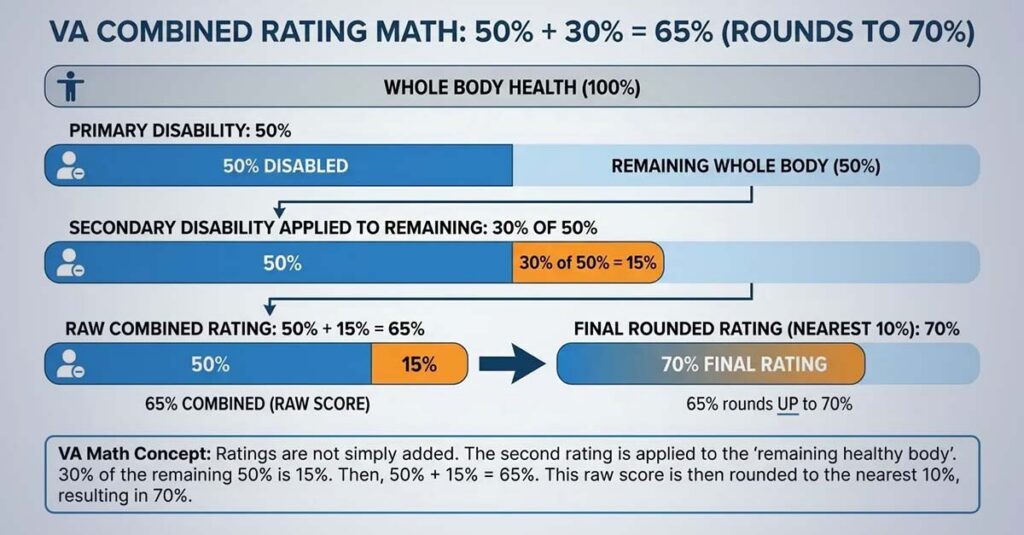
When a veteran has more than one service-connected disability, the VA does not simply add the individual percentages together. According to the VA, combined disability ratings are calculated using a combined ratings table that accounts for the interaction between multiple disabilities, and the VA’s published combined ratings table is publicly available for reference.
Per VA guidance, the calculation orders disability ratings from highest to lowest, applies the combined ratings table sequentially, and rounds the final combined value to the nearest 10 percent. This method means a veteran’s combined rating reflects a mathematical formula defined by regulation rather than a simple sum of individual percentages. Because the formula treats each additional disability as a percentage of a veteran’s remaining, non-disabled capacity rather than a flat addition, two disabilities with the same individual percentages can produce different combined outcomes depending on the order in which they are applied and the veteran’s existing combined rating.
Current VA Disability Compensation Rates
VA disability compensation rates are published annually and vary based on combined rating percentage and dependent status. According to the VA, current disability compensation rates reflect the applicable monthly payment amount for each combined rating level, adjusted periodically for cost-of-living changes. These published rate tables represent publicly available, VA-sourced information about how combined ratings translate into monthly compensation amounts, and they are the authoritative source for current payment figures rather than any third-party estimate.
Disability Benefits Questionnaires and Clinical Criteria
Disability Benefits Questionnaires (DBQs) are standardized forms completed by licensed medical professionals to document a veteran’s current condition in a format aligned with the VA’s rating criteria. According to the VA, public DBQs are available directly through the VA and can be used to submit medical evidence from a treating provider as part of a claim.
Each DBQ question reflects clinical criteria established in 38 CFR Part 4 for that specific condition. Musculoskeletal DBQs, for example, incorporate range-of-motion measurements because orthopedic research has established specific thresholds correlated with functional limitation. Respiratory DBQs incorporate specific pulmonary function values because that research is recognized as a reliable indicator of impairment. Mental health DBQs are structured around the same occupational and social impairment categories found in 38 CFR § 4.130, which is why the clinical detail captured on these forms corresponds directly to the applicable rating criteria.
The VA Claim Exam Process
In some cases, the VA schedules a claim examination, sometimes called a Compensation & Pension (C&P) exam, to evaluate a claimed condition. According to the VA, the VA claim exam is used to determine whether a disability is related to service and to assess the severity of a disability where applicable. The examiner’s findings, along with the medical evidence already in a veteran’s file, contribute to the overall evidentiary record the VA reviews when making a rating decision.

Distinguishing Current Diagnosis From Service Connection
The VA evaluates two distinct elements when reviewing most claims: whether a veteran currently has a diagnosed condition, and whether that condition is connected to military service. Clinical literature on diagnostic criteria supports the first element, while epidemiological and occupational research on causation and exposure supports the second. Comprehensive medical documentation completed by a licensed provider is designed to address both elements as part of a complete medical record submitted for VA review, since evidence that thoroughly establishes one element does not automatically establish the other.
Decision Reviews When a Veteran Disagrees With a Rating
Several formal review pathways exist for veterans who disagree with a VA rating decision. According to the VA, decision reviews and appeals consist of a Supplemental Claim, a Higher-Level Review, or a Board Appeal, each involving distinct evidentiary standards. Per the VA’s guidance on choosing a decision review option, a Supplemental Claim allows a veteran to submit new and relevant evidence that was not previously considered, a Higher-Level Review provides for a review of the same evidence by a senior VA adjudicator using VA Form 20-0996, and a Board Appeal allows a Veterans Law Judge to review the case. A Supplemental Claim is requested using VA Form 20-0995.
Per the VA’s Decision Reviews FAQs, veterans who disagree with a decision may request one of these review options, and updated medical evidence often plays a role in how a Supplemental Claim or subsequent review is resolved.
The Role of Private and Independent Medical Evidence
The VA reviews all relevant evidence submitted with a claim, including private and independent medical evidence, not solely records generated within the VA system. Private specialists may complete detailed clinical evaluations, and private diagnostic testing can supply objective evidence, such as imaging or laboratory results, that supplements the existing record. Per VA guidance, this evidence is weighed according to its relevance, clinical detail, and how directly it addresses the applicable rating criteria under 38 CFR Part 4.
This means that a complete evidentiary record often includes a combination of VA treatment records, any C&P examination findings, and independent medical evaluations obtained from outside providers, each contributing a different layer of clinical detail to the overall picture the VA reviews.

REE Medical’s Role in Coordinating Independent Documentation
REE Medical coordinates independent medical evaluations and Disability Benefits Questionnaires completed by licensed healthcare professionals who are familiar with disability-focused documentation and VA-standardized forms. REE Medical does not prepare, present, or submit VA disability claims and does not provide legal or representational services under 38 U.S.C. § 5901 or 38 U.S.C. § 5904.
Licensed providers coordinated through REE Medical complete objective medical documentation that reflects a veteran’s current condition and functional status, consistent with standard clinical practice and the criteria set out in the VA’s rating schedule. Veterans can learn more about coordinating independent, VA-compliant medical evaluations by contacting REE Medical for a complimentary, informational consultation.
Understanding the Framework Behind Rating Decisions
VA disability ratings are the product of a structured regulatory framework rather than a subjective assessment of how severe a condition feels day to day. The rating schedule under 38 CFR Part 4, the mental disorders formula under 38 CFR § 4.130, presumptive condition standards expanded under the PACT Act, the combined ratings table, and the distinct evidentiary requirements for current diagnosis versus service connection all shape how a claim is ultimately evaluated. Medical documentation completed by licensed providers that reflects these regulatory criteria gives the VA a clearer clinical picture to review, though the VA remains the sole agency authorized to determine service connection or assign a disability rating, and outcomes depend on the specific facts and evidence in each individual case.
Disclosure
DISCLAIMER: REE Medical, LLC is not a Veterans Service Organization (VSO) or a law firm and is not affiliated with the U.S. Veterans Administration (“VA”). Results are not guaranteed, and REE Medical, LLC makes no promises. REE Medical’s staff does not provide medical advice or legal advice, and REE Medical is not a law firm. Any information discussed, such as, but not limited to, the likely chance of an increase or service connection, estimated benefit amounts, and potential new ratings, is solely based on past client generalizations and not specific to any one patient. The doctor has the right to reject and/or refuse to complete a Veteran’s Disability Benefit Questionnaire if they feel the Veteran is not being truthful. The Veteran’s Administration is the only agency that can make a determination regarding whether or not a Veteran will receive an increase in their service-connected disabilities or make a decision on whether or not a disability will be considered service-connected. This business is not sponsored by, or affiliated with, the United States Department of Veterans Affairs, any State Department of Military and Veterans Affairs, or any other federally chartered veterans service organization.