

Virginia Disabled Veteran Benefits: The State Programs, Rating Standards, and Administering Agencies
Virginia’s veterans with service-connected disabilities have access to a range of state-level programs — a real property tax exemption, a vehicle tax exemption, education waivers for survivors and dependents, state veterans care centers, employment preference in Commonwealth hiring, and state park and license fee relief — that operate separately from federal VA programs. Several of these programs are defined directly by the Constitution of Virginia and the Code of Virginia, and their eligibility standards are narrower and more specific than they are often described. This article outlines what each program covers, which agency administers it, and what the governing law actually requires.
The programs described here use different rating standards and are administered by different bodies: the Virginia Department of Veterans Services, local commissioners of the revenue, the Virginia Department of Wildlife Resources, the Department of Conservation and Recreation, and the U.S. Department of Veterans Affairs. This article outlines the principal Virginia state programs available to veterans with service-connected disabilities, the rating standards each one uses, and the agency responsible for administering it.
How Virginia’s Property Tax Exemption Effective Date Works
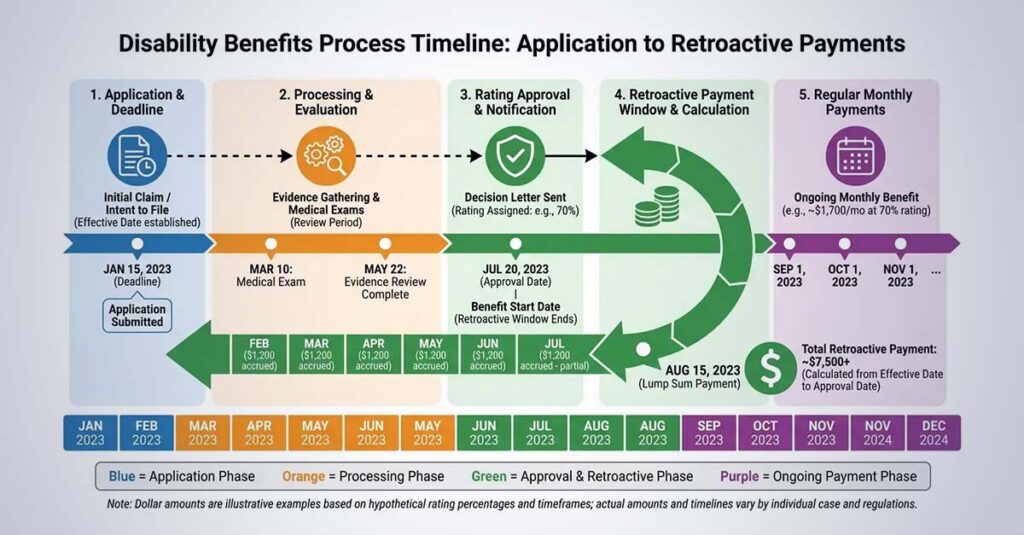
Virginia’s real property tax exemption for veterans does not depend on when an application is submitted. Under the Code of Virginia, where a veteran’s disability rating occurs after January 1, 2011 and the veteran owns a qualifying primary residence on the date of the rating, the exemption begins on the date of that rating. Where the residence is acquired after the rating, the exemption begins on the date of acquisition. Department of Veterans Services regulations state the same rule and add that a locality may not impose an income limitation, an asset limitation, or an application deadline on the exemption.
The one consequence of a later filing is narrow and financial: the statute provides that no locality is liable for interest on a refund of taxes paid before the veteran submitted the required affidavit. The tax itself is still refunded. Federal VA disability compensation follows its own rules on back pay for a rating increase, which are separate from Virginia’s state exemption.

Virginia’s Real Property and Vehicle Tax Exemptions
Virginia’s full real property tax exemption for veterans rated 100% permanently and totally disabled is widely recognized. What is less widely understood is that the exemption is not a local option and does not vary by jurisdiction. Article X, Section 6-A of the Constitution of Virginia directs that the General Assembly shall exempt the real property of a veteran the U.S. Department of Veterans Affairs has determined to have a one hundred percent service-connected, permanent, and total disability, where the veteran occupies the property as a principal place of residence. Department of Veterans Services regulations define a qualified veteran the same way and state that where a 100% rating is not permanent — because it has not been finally adjudicated or is scheduled for future review — the exemption does not apply. The Department of Veterans Services notes one related pathway: veterans rated below 100% whom the VA pays at the 100% rate due to individual unemployability and who are rated permanent and total also qualify.
Localities have almost no discretion here. A locality must exempt the dwelling and land not exceeding one acre, and may exempt additional acreage only if it already exempts or defers tax on more than one acre under the separate elderly-and-disabled program. Separately, the Department of Veterans Services notes that Va. Code § 58.1-3506 authorizes but does not require a locality to set a lower vehicle tax rate for a veteran who has lost or lost the use of a leg, arm or hand, is blind, or is certified permanently and totally disabled. That local option is the only jurisdiction-by-jurisdiction variation in Virginia’s veteran property tax framework.
Fairfax County, for example, publishes the same standard the state law sets: the exemption requires a rating of 100% service-connected, permanent and total, or a rating below 100% where the VA pays at the 100% rate because of individual unemployability. The county’s base real estate rate for tax year 2025 was $1.1225 per $100 of assessed value, and it taxes most vehicles at $4.57 per $100, with a special $0.01 per $100 subclass for vehicles owned by qualifying disabled veterans.
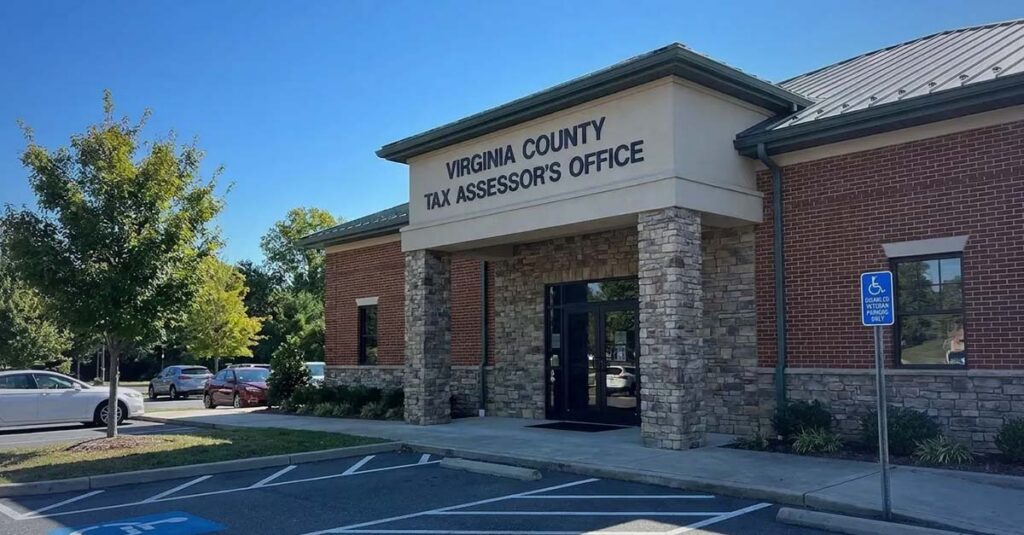
A 100% permanent and total VA disability rating is the standard for both of Virginia’s veteran tax exemptions, and both apply statewide rather than in selected localities. The vehicle exemption is separate and narrower: the Code of Virginia exempts one motor vehicle — a passenger car, pickup, or panel truck registered for personal use — owned and used primarily by or for a veteran rated 100% service-connected permanent and total. It applies from the later of the vehicle’s acquisition date or January 1, 2021, and it ends on the veteran’s death rather than passing to a surviving spouse. For both exemptions, the Code of Virginia directs that the claim be presented to the commissioner of the revenue of the locality, not the tax assessor.
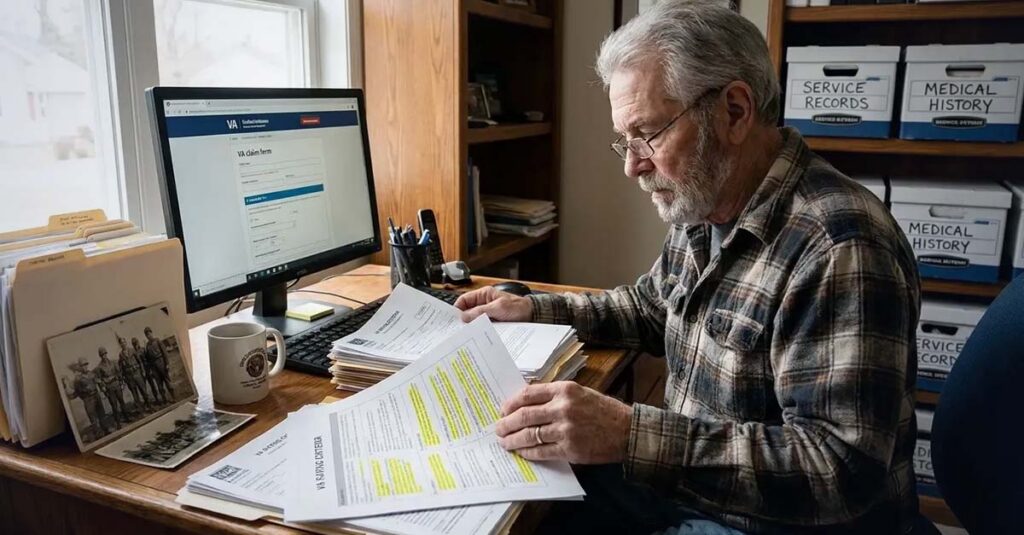
According to Department of Veterans Services regulations, the exemption is claimed by affidavit or written statement supported by the veteran’s VA Summary of Benefits letter documenting the 100% service-connected permanent and total rating. The Code of Virginia provides that a veteran need only refile if the principal place of residence changes, and that a veteran under contract to purchase a Virginia home may apply before closing, with the locality required to process the application within 20 business days. A locality may require an annual certification of continued occupancy, but may not impose an application deadline. Department of Veterans Services regulations also provide that the exemption continues while the veteran resides in a hospital or nursing home, provided the property is not leased to others, and that a veteran denied the exemption by a locality may appeal to the Commissioner of the Department of Veterans Services and from there to circuit court.
The exemption does not extend to secondary properties. It applies to the dwelling the veteran occupies as a principal place of residence, together with land not exceeding one acre unless the locality already exempts or defers tax on more acreage under its elderly-and-disabled program. Beyond the dwelling itself, the Code of Virginia exempts other improvements only where they are used principally to house or cover a motor vehicle or household goods and for other than a business purpose — a garage or storage shed, not an income-producing structure. Land the veteran does not own is not exempt.
The exemption continues for a surviving spouse who does not remarry and continues to occupy the property as a principal residence, and the spouse may move to a different principal residence and retain it. A 2024 constitutional amendment, effective January 1, 2025, broadened the survivor provision from a service member killed in action to one who died in the line of duty. The vehicle exemption works differently: the Code of Virginia states it expires on the date of the veteran’s death and does not extend to a surviving spouse, a limitation Fairfax County restates in its own guidance.
Two further tax provisions sit outside the property tax framework. Army benefits resources summarizing Virginia’s programs describe a motor vehicle sales and use tax exemption for a veteran rated 100% service-connected total and permanent, covering the purchase of one vehicle, with a DMV Purchaser’s Statement of Tax Exemption and a VA Benefit Summary Letter used as documentation; a vehicle purchased by a spouse can qualify where it is used primarily by or for the veteran. Separately, the Department of Veterans Services states that the Virginia Military Benefits Subtraction on state income tax is $40,000 for taxable year 2025 and after, up from $30,000 for taxable year 2024.

Virginia Department of Veterans Services Support Programs
The Virginia Department of Veterans Services administers Virginia’s state veterans programs. Its principal direct-support program is Virginia Veteran and Family Support, which the department describes as providing needs assessment, personalized care and community resource coordination, peer recovery support, and linkages to financial and benefits services, transportation, housing, employment, and education assistance programs. It serves veterans of any era who are Virginia residents regardless of discharge status, along with National Guard and Reserve members, transitioning service members, family members, and caregivers. It is a coordination and referral program rather than a grant program.
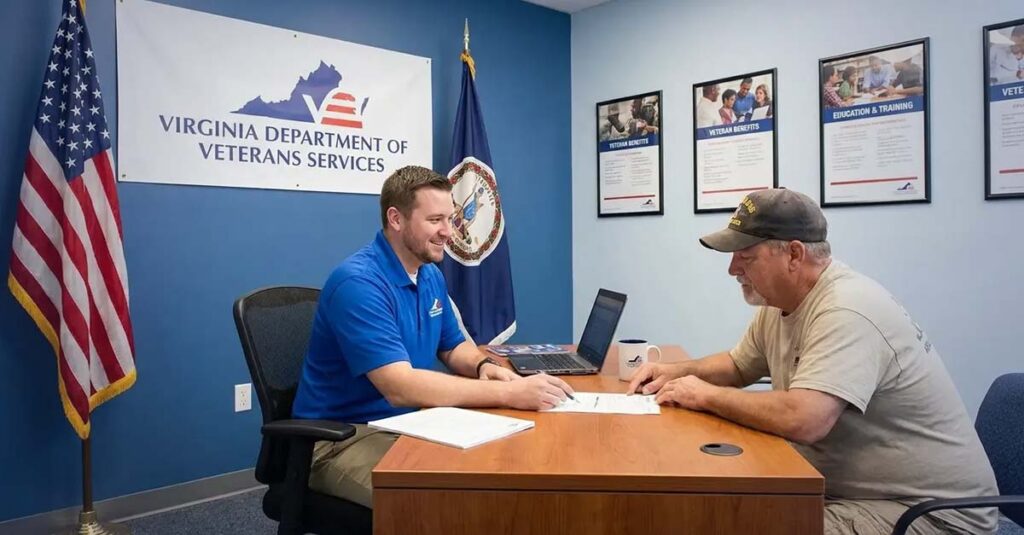
The department also operates Benefits Service Offices across the Commonwealth, where accredited veterans service representatives provide claims assistance at no cost. The department publishes a directory of those offices. Supplemental funding for selected department programs flows through the Virginia Veterans Services Foundation, an independent entity of the Commonwealth that the department describes as providing funding where state and federal resources are not available.
A separate fund, the Virginia Military Family Relief Fund, is sometimes described as a general veterans’ emergency grant program. It is not. The Code of Virginia establishes it as a fund administered by the Office of the Adjutant General — part of the Virginia Department of Military Affairs, not the Department of Veterans Services — and directs that its moneys be used solely to assist members of the Virginia National Guard, and Virginia residents serving in the reserves of the U.S. armed forces, who have been called to extended federal active duty for periods in excess of 90 days, together with their families. The statute describes assistance with living expenses including food, housing, utilities, and medical services, available from the date of entry onto active duty until 180 days after release. It sets no maximum grant amount.
Virginia operates four veterans care centers: the Puller Veterans Care Center in Fauquier County, the Sitter & Barfoot Veterans Care Center in Richmond, the Davis & McDaniel Veterans Care Center in Roanoke, and the Jones & Cabacoy Veterans Care Center in Virginia Beach. The Department of Veterans Services describes them as providing in-patient residential skilled nursing care, memory care, and short-term rehabilitative care. The newest, Puller, is a 128-bed facility in Warrenton built on the former Vint Hill Farms Station, with all private rooms organized into households and neighborhoods. Published admission criteria turn on Virginia residency at the time of entry into service or at admission, qualifying active-duty service, a discharge other than dishonorable for the last term of service, and a clinical need for skilled nursing care.
VA Health Care Priority Groups and Copays
According to the VA, a veteran may be assigned to Priority Group 1 where a service-connected disability is rated 50% or more disabling, where the VA has concluded the veteran is unable to work, or where the veteran received the Medal of Honor. Income is not a factor in that assignment. Copay treatment is broader than the priority group alone: the VA states that a veteran with a service-connected rating of 10% or higher owes no copay for outpatient or inpatient care, and that care related to a VA-rated service-connected disability requires no copay for any veteran. Understanding VA disability ratings is useful context for reading the priority group tables.
Medication copays follow the priority group. The VA states that a veteran in Priority Group 1 pays no copay for any medications. Veterans in priority groups 2 through 8 may owe copays only for medications prescribed for non-service-connected conditions and for over-the-counter medications obtained from a VA pharmacy, at 2026 rates ranging from $5 to $33 depending on medication tier and days of supply — and the VA applies an annual copay cap of $700 per calendar year across all medication copays.
The Program of Comprehensive Assistance for Family Caregivers uses a fixed rating threshold rather than a sliding scale. The VA Caregiver Support Program states that eligibility requires a serious injury or illness incurred or aggravated in the line of duty, defined as a service-connected disability rated at 70% or more alone or in combination, together with a need for in-person personal care services for a minimum of six continuous months based on an inability to perform an activity of daily living, a need for supervision or protection, or a need for regular or extensive instruction. The veteran must also receive care at home and ongoing care from a VA primary care team.
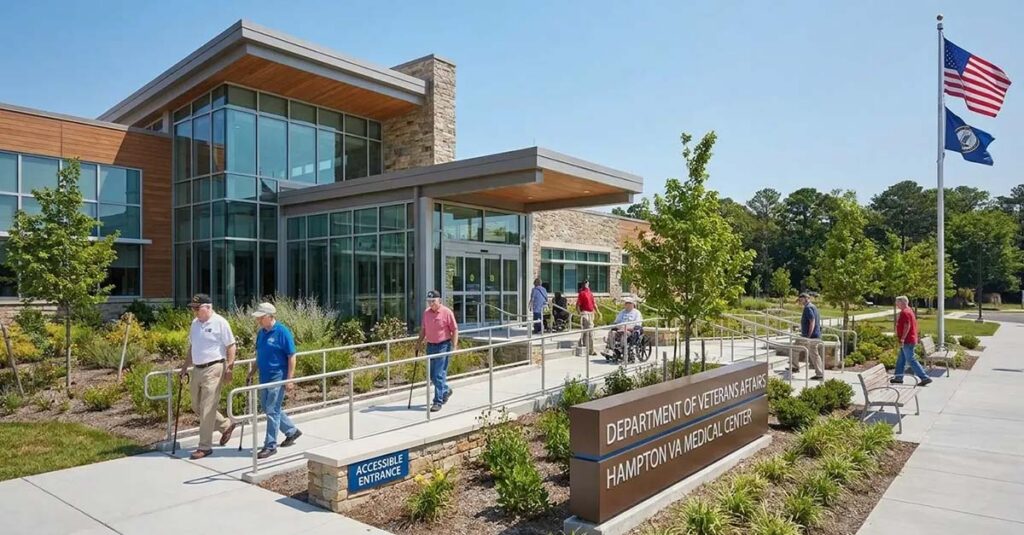
Understanding the scope of VA disability benefits for PTSD is relevant here, though access to VA mental health services is not tiered by rating percentage — the VA states that readjustment counseling and related mental health services carry no copay for any veteran regardless of rating or priority group. Virginia hosts two of the VA’s national Spinal Cord Injuries and Disorders Centers, at the Hampton VA Medical Center and the Richmond VA Medical Center. The Richmond facility also lists blind and low vision rehabilitation and substance use programming that includes population-specific groups for combat trauma survivors and veterans with PTSD. Access to these services is governed by clinical referral requirements rather than by disability percentage.
Virginia State Employment Preference for Veterans
The Code of Virginia establishes a veterans’ preference in Commonwealth employment. Where a position is filled on the basis of a written examination, a veteran’s grade or rating is increased by five percent; where the veteran has a service-connected disability rating fixed by the U.S. Department of Veterans Affairs, the increase is ten percent. The increase applies only where the veteran passes the examination. Where a position is not filled on the basis of an examination, the statute directs that a veteran, surviving spouse, or child who meets all the knowledge, skill, and ability requirements be given preference during the selection process, with additional consideration for veterans who have a service-connected disability rating. Members of the Virginia National Guard who have completed required initial active-duty service have a separate five percent preference on scored assessments, though it does not apply to positions limited to state employees or where another applicant is a veteran or former prisoner of war.
The statute also provides that a veteran, surviving spouse, child, or Guard member denied Commonwealth employment is entitled, to the extent permitted by law, to request and inspect information regarding the reasons for the denial. Veterans transitioning from military service to civilian careers sometimes encounter descriptions of additional Virginia preferences applying to probationary periods, layoffs, reassignment, or promotions. Section 2.2-2903 addresses application for employment; it does not create probationary, retention, reassignment, or promotional preferences.
The Virginia Military Survivors and Dependents Education Program
The Virginia Military Survivors and Dependents Education Program waives tuition and mandatory fees at Virginia public institutions of higher education for admitted qualified survivors and dependents, as certified by the Commissioner of Veterans Services. The Department of Veterans Services describes the waiver as covering eight semesters. The Code of Virginia defines a qualified survivor or dependent as the spouse, or a child between the ages of 16 and 29, of either a service member who — while on active duty during military operations against terrorism, on a peacekeeping mission, as a result of a terrorist act, or in any armed conflict — was killed, became missing in action, or became a prisoner of war; or of a veteran who, due to such service, has been rated by the U.S. Department of Veterans Affairs as totally and permanently disabled or at least 90 percent permanently disabled and was discharged under conditions other than dishonorable. The statute also provides that the Commissioner may certify dependents above the age of 29 where extenuating circumstances prevented use of the benefit before age 30, and that a stepchild of a deceased service member is treated as a child where the member claimed the stepchild on a tax return or in DEERS while on active duty.
Eligibility also depends on a Virginia connection. The statute requires that the service member established domicile in Virginia at the time of entering active service or being called to active duty, or established domicile or physical presence in the Commonwealth for at least five years immediately before the dependent’s admission application was submitted, with parallel rules where the member or a surviving spouse is deceased. The Department of Veterans Services asks for one document per year proving five years of presence where Virginia is not the Home of Record upon entry into service.
The full range of benefits available to spouses and family dependents of disabled veterans extends beyond education. Alongside the tuition waiver, the Code of Virginia establishes a separate Virginia Military Survivors and Dependents Education Fund providing financial assistance of up to $2,000, or as provided in the general appropriation act, toward room and board, books and supplies, capped so that the total combined with any other scholarship, grant or waiver does not exceed actual educational costs. The Department of Veterans Services notes the stipend is available to Tier 2 participants, is paid once per semester, and its amount is set annually by the State Council of Higher Education for Virginia based on enrollment status, the number of participating students, and available funding. The department publishes application target dates of July 1 for fall, November 1 for spring, and April 1 for summer. The program has been amended repeatedly, most recently in 2025, and the department’s reference to a Preserving VMSDEP Task Force reflects continuing legislative attention; its terms are subject to change.
Effective Dates, Refunds, and the Vehicle Registration Fee Waiver
Virginia’s exemptions each carry their own effective-date rule, and none of them is set by the calendar year in which paperwork arrives. The real property exemption begins on the date of the rating or, for a later-acquired home, the date of acquisition. The one-vehicle personal property exemption applies from the later of the vehicle’s acquisition date or January 1, 2021. Where tax has already been paid, Department of Veterans Services regulations describe a refund of the tax, with the statute limiting only the locality’s liability for interest.
Virginia’s registration fee waiver operates on a different basis again. The Code of Virginia provides that no annual registration fee is required for one motor vehicle owned and used personally by a veteran certified by the U.S. Department of Veterans Affairs as having a service-connected disability, or by that veteran’s unremarried surviving spouse, where the vehicle displays DV plates or standard passenger plates. Unlike the tax exemptions, that waiver carries no percentage threshold.

The Rating Standards Virginia Programs Actually Use
Virginia’s programs use fewer thresholds than are often described, and most of them sit at the top of the scale. The real property exemption, the one-vehicle personal property exemption, the motor vehicle sales and use tax exemption, and the state parks Disabled Veteran’s Passport all require a 100% service-connected rating — permanent and total in the case of the tax exemptions. The education program uses a different standard: totally and permanently disabled or at least 90 percent permanently disabled, plus a Virginia domicile test. The graduated tiers that do exist appear in one place: the Department of Wildlife Resources fee schedule for the resident disabled veteran lifetime license, which prices freshwater fishing and hunting licenses at $100 each at 30% to less than 50%, $75 each at 50% to less than 70%, $50 each at 70% or more, and no charge for a veteran rated totally and permanently disabled, with a $15 trapping license at that level.
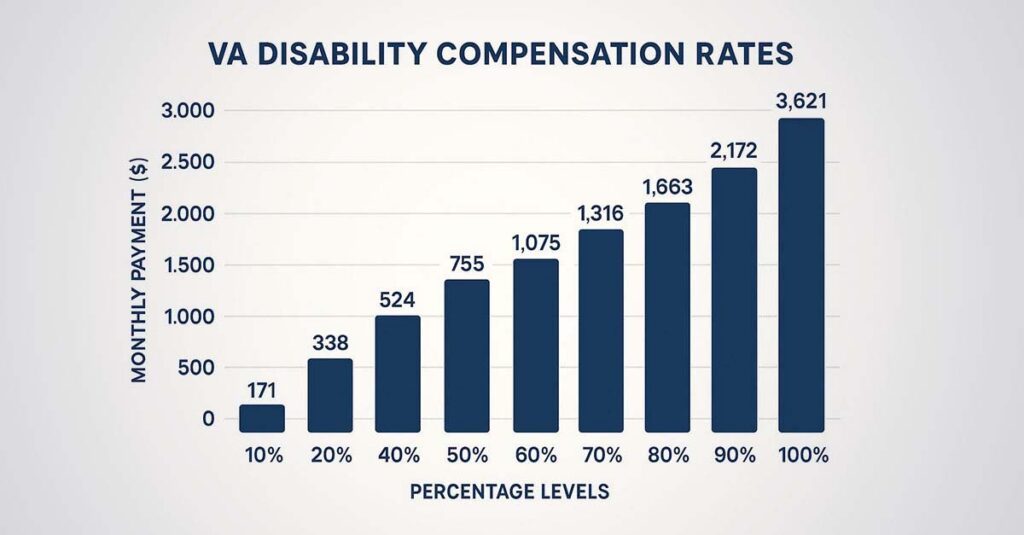
Federal VA compensation rates are published separately. For 2026, effective December 1, 2025, the VA’s monthly rate for a veteran alone is $795.84 at 40%, $1,132.90 at 50%, $2,362.30 at 90%, and $3,938.58 at 100%.
Virginia’s disabled veteran license plates are available to any veteran the U.S. Department of Veterans Affairs has certified as having a service-connected disability, with no percentage threshold. The Code of Virginia is explicit that plates issued on that basis do not permit use of parking spaces reserved for persons with disabilities. A separate DV disabled parking plate, which does confer that privilege, requires certification by a licensed clinician that the veteran’s disability limits or impairs the ability to walk.
Financial Protections and Fee Relief in Virginia
The 6% interest rate cap that is sometimes attributed to Virginia law is federal, and it is narrower than usually described. No act by the name “Virginia Military Servicemembers and Veterans Protection Act” appears in the Code of Virginia popular-name index. Under the Servicemembers Civil Relief Act, the cap applies to an obligation incurred by a servicemember — or jointly with a spouse — before the servicemember entered military service, and it runs during the period of military service, extending one additional year only for a mortgage or similar security instrument. The servicemember must give the creditor written notice with a copy of the military orders no later than 180 days after termination or release from military service. It is not a benefit available to veterans on the basis of a service-connected disability.
Virginia does authorize local property tax deferral, but not as a veterans’ program. The Code of Virginia permits the governing body of a locality, by ordinance, to provide for exemption from or deferral of real estate tax for anyone at least 65 years of age or, where the ordinance so provides, anyone found permanently and totally disabled. Where an ordinance provides for deferral, it may charge interest not exceeding eight percent per year on the deferred amount, and the accumulated deferred taxes and interest constitute a lien on the real estate, payable on sale, on a nonqualifying transfer, or from the estate within one year of the last qualified owner’s death. Income and other eligibility conditions are set locality by locality.
Fee relief is available in two areas. The Department of Wildlife Resources issues a resident disabled veteran lifetime hunting and fishing license at reduced or no cost, with pricing beginning at a 30 percent rating rather than 50 percent, and the license is a one-time purchase rather than an annual charge. Separately, the Code of Virginia establishes a Disabled Veteran’s Passport for a veteran with a 100 percent service-connected disability rating, issued on presentation of a letter from the U.S. Department of Veterans Affairs or the discharging service. The Department of Conservation and Recreation states that the passport is free and covers vehicle parking, admission for the holder and anyone needed to assist the holder, boat launch fees and horse trailer parking, with a 50 percent discount on camping, swimming, shelters and park-operated equipment rentals, and a 25 percent discount on a one-night standard yurt. The passport is tied to the rating, not to license plates.
Concealed handgun permit fees are not waived for veterans. The Code of Virginia caps total permit processing at $50 and limits fee waivers to specified retired public safety and judicial personnel, a list that does not include veterans; localities have no separate waiver authority.
REE Medical and Independent Medical Documentation
Documentation quality matters at several points in this landscape, though the documents each program uses differ. Medical documentation that describes a diagnosis without also describing functional limitations, symptom frequency, or impact on daily activity gives the VA less to work with when it applies its rating criteria.
REE Medical coordinates access to independent, licensed healthcare professionals who complete VA Disability Benefits Questionnaires (DBQs) and objective medical evaluations. These are standardized medical documents the VA uses as part of its evaluation process. REE Medical’s providers are familiar with VA documentation formats and the evidence standards associated with different diagnostic codes and rating criteria.
REE Medical does not prepare, present, or submit VA disability claims and does not provide legal or representational services. REE Medical coordinates independent clinical evaluations and VA-standardized forms that describe a veteran’s medical history in clinical terms. Virginia’s property tax exemptions are a separate matter: Department of Veterans Services regulations require a VA Summary of Benefits letter documenting the rating, not clinical records.
Final Thoughts
Virginia offers veterans with service-connected disabilities a substantial set of state programs. The programs described throughout this article — the constitutionally mandated real property exemption, the one-vehicle personal property exemption, Department of Veterans Services support programs, the four state veterans care centers, VMSDEP education waivers, Commonwealth employment preference, and state park and license fee relief — are each administered by a specific agency under a specific statutory standard.
Virginia’s programs are defined by statute and regulation, and their standards are published by the agencies that administer them — the Department of Veterans Services, local commissioners of the revenue, the Department of Wildlife Resources, and the Department of Conservation and Recreation. The common challenges veterans face often begin with incomplete clinical documentation of service-connected conditions. Veterans can learn more about coordinating independent medical evaluations by scheduling a complimentary consultation with REE Medical.
DISCLAIMER: REE Medical, LLC is not a Veterans Service Organization (VSO) or a law firm and is not affiliated with the U.S. Veterans Administration (“VA”). Results are not guaranteed, and REE Medical, LLC makes no promises. REE Medical’s staff does not provide medical advice or legal advice, and REE Medical is not a law firm. Any information discussed, such as, but not limited to, the likely chance of an increase or service connection, estimated benefit amounts, and potential new ratings, is solely based on past client generalizations and not specific to any one patient. The doctor has the right to reject and/or refuse to complete a Veteran’s Disability Benefit Questionnaire if they feel the Veteran is not being truthful. The Veteran’s Administration is the only agency that can make a determination regarding whether or not a Veteran will receive an increase in their service-connected disabilities or make a decision on whether or not a disability will be considered service-connected. This business is not sponsored by, or affiliated with, the United States Department of Veterans Affairs, any State Department of Military and Veterans Affairs, or any other federally chartered veterans service organization.