


VA Form 21-0845: What Happens After You Submit It (And Why That Matters More Than the Form Itself)
VA Form 21-0845 authorizes the release of a veteran’s medical records to the Department of Veterans Affairs — but submission is only the beginning of a multi-step process involving regional offices, federal records centers, and private medical providers, each operating on independent timelines and with distinct failure points. Most guides focus on completing and signing the form. This article focuses on what happens after the form is submitted, because this is where evidence gaps, processing delays, or administrative issues may occur.
Understanding the post-submission lifecycle of VA Form 21-0845 allows veterans and their families to monitor records retrieval actively, identify problems before they affect claim outcomes, and make informed decisions about supplementing the VA’s records-gathering process with direct evidence submission.
Why the Post-Submission Process is Important
Submitting VA Form 21-0845 triggers a multi-stage administrative process that spans multiple agencies and third parties, none of which communicate in real time. The authorization does not go directly to the treating physician. It routes through the VA regional office to a records processing team, which then generates individual requests to each listed provider. Those providers respond — or do not respond — on their own timelines. Meanwhile, the VA does not pause the claim during this process. The rating review proceeds based on whatever evidence exists when the claims file is pulled.
The Multi-Party Chain the Authorization Sets in Motion
A signed form enters the VA regional office, gets logged, and joins a processing queue. A records coordinator eventually works the claim and creates individual records requests for each listed provider. Those requests are sent by mail or fax. Providers receive them, route them through their records departments, and respond according to their own internal timelines. The VA logs each request with a sent date and sets a follow-up date, typically 45 days out. Whether that follow-up occurs depends on staffing and workload at the regional office.
Veterans may receive confirmation that the VA received the form — not that the VA successfully obtained records from any provider. If a provider does not respond, the claim proceeds. If a records request was sent to an outdated address and never arrived, the claim may proceed. The VA does not issue notifications when records retrieval fails.
To illustrate what this looks like in practice: a Marine veteran filed for a back condition in March, submitting a 21-0845 that listed his orthopedic surgeon and primary care physician. Six months later, he received a denial citing insufficient medical evidence. A review of his claims file revealed that the VA had successfully obtained records from his primary care doctor but never received anything from the orthopedist. The VA had sent the request to the surgeon’s address from 2019. The practice had relocated in 2021. The request never reached the correct location, no follow-up occurred, and the claim was rated based on incomplete evidence. A supplemental claim was ultimately required, adding eight months to the process.
The common challenges veterans face in VA disability advocacy often trace back to precisely these records retrieval failures — administrative breakdowns that are invisible to veterans until a decision letter arrives.

The Authorization Window: How Long Your 21-0845 Actually Works
Per VA policy, VA Form 21-0845 authorizes record release for one year from the date the veteran signs the form — not from the date the VA receives it, and not from the date records requests are sent. A form signed in January 2024 expires in January 2025, regardless of whether the VA has acted on it or whether the claim is still pending.
The VA does not notify veterans when authorizations expire. Claims that extend beyond 12 months — and many do — may reach a point where a rating specialist needs clarifying records but cannot request them because the authorization is no longer valid. At that stage, the VA must send the veteran a request for a new form, adding 30–45 days while the form is completed and returned, then another 60–90 days for records retrieval.
What Happens When Authorization Expires Mid-Claim
An expired authorization mid-claim produces one of three outcomes: the VA sends a request for a new 21-0845 and the claim re-enters the queue; the VA rates the claim based on existing evidence, which may be incomplete; or the request for additional documentation is lost in administrative processing and the claim closes without the information that could have affected the outcome.
Supplemental claims and appeals create additional authorization gaps. A supplemental claim filed two years after an initial denial requires fresh authorization — the VA can reference records already in the claims file, but cannot request new or updated information without a current authorization. Appeals create longer windows of exposure; a case pending for 18 months may have an expired authorization by the time the Board of Veterans Appeals identifies a need for additional medical evidence.

Authorization Expiration Tracking Reference:
- Record the exact date the 21-0845 was signed (not the date it was mailed)
- At the 10-month mark, review pending claim status — if still unresolved, a refreshed authorization is advisable
- A new authorization should reference the pending claim number in the remarks section
- For pending appeals, review authorization dates every six months
- Supplemental claims generally require a new authorization regardless of the original form’s expiration date
- Retain copies of all submitted authorizations with dates clearly noted
What the VA Does With Your Form (The Part Nobody Explains)
Upon receipt, VA Form 21-0845 is scanned into the Veterans Benefits Management System (VBMS) within a few days. A claims assistant reviews the form to confirm it is signed, dated, and contains at least one provider with contact information. Incomplete or illegible submissions are flagged, generating a request for a corrected form — adding two to four weeks to the process before records retrieval can begin.
Once the form passes initial review, it is associated with the claims file and placed in queue for a records coordinator to generate outbound requests. That queue wait varies by regional office workload from days to months.
How the VA Generates Records Requests
When a records coordinator reaches the claim, individual requests are created for each listed provider. These include the signed authorization, a cover letter specifying what records the VA needs, and a 30-day response deadline. Requests are transmitted by mail or fax. Fax transmissions create a paper trail but are subject to misfiling, illegibility, and routing to incorrect departments — particularly in large health systems. The VA logs each request with a sent date and schedules a follow-up, typically at 45 days, to check for provider response. The consistency of that follow-up is variable.

The Records Receipt and Integration Process
Records that arrive from providers are sent to a VA mail processing center, scanned, and entered into a digital queue for association with the claims file. This takes one to three additional weeks. A document processor confirms that the patient name, date of birth, and Social Security number on the records align with the claims file. Any discrepancy — a maiden name, a typographical error, a transposed digit — may result in the records being flagged for manual review or, in some cases, associated with the wrong veteran’s file.
To illustrate how name discrepancies cause delays: an Army veteran submitted a 21-0845 listing her maiden name, which appeared on medical records from 2015–2018. Her current legal name after marriage was different. When the provider sent records, the VA’s document processor flagged them for manual review due to the name mismatch. The records remained in a verification queue for six weeks. Including a notation on the 21-0845 explaining the name change and providing both names would have given the document processor the context needed to associate the records immediately.
When Medical Providers Ignore VA Requests Despite Your Authorization
A signed authorization gives providers permission to release records. It does not obligate them to do so, and it does not elevate VA records requests above other administrative priorities. Private medical practices process records requests from insurance companies, attorneys, other medical providers, and patients simultaneously. A VA disability claim request does not carry the urgency of a legal subpoena or an active treatment authorization.
Small practices may have one staff member handling all records requests on a limited schedule. Large hospital systems have dedicated release-of-information departments processing thousands of requests. In both cases, response timelines are determined by internal workload — not by the VA’s 30-day deadline.
The Contact Information Problem
Records requests sent to outdated addresses represent one of the most common and preventable causes of evidence gaps. A practice that relocated, a provider with multiple locations, or a hospital network with separate campuses can all result in a records request that never reaches the party holding the relevant records. The VA does not receive bounce-back notifications for mailed requests that arrive at incorrect addresses. The 30-day and 45-day follow-up windows pass without resolution, and the claim proceeds.
When Providers Respond Incompletely
Incomplete records responses are more problematic than non-responses because they create a false sense of completion. When a provider sends visit summaries but omits diagnostic test results, or sends records from one period but not another, the VA marks the records request as fulfilled. The claim proceeds with partial evidence. The gap is not identified until the rating decision references incomplete medical history.
The Records Gap: Why Your 21-0845 Might Not Cover Everything
The VA requests records only from providers explicitly listed on VA Form 21-0845. If a provider is not listed, no request is sent — and the VA does not notify the veteran that potentially relevant records were not retrieved. The burden of comprehensive provider identification falls entirely on the veteran at the time of submission.
Common providers that veterans overlook include emergency department visits that occurred years before a formal diagnosis, urgent care clinics accessed when primary care appointments were unavailable, physical therapists and chiropractors seen for rehabilitation, and mental health providers at a different practice from the primary treating psychiatrist.
When Treatment Spans Multiple Systems
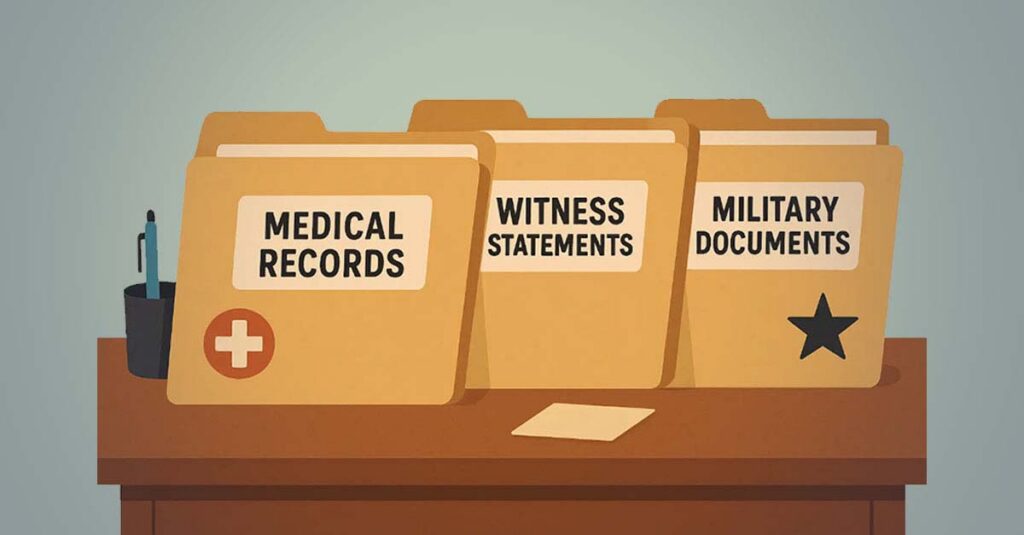
Veterans who received care at military treatment facilities, VA healthcare facilities, and private providers have medical histories distributed across systems that do not share data. Military records require a separate process — Standard Form 180 — through the National Archives. VA records should be accessible to the VA, but records from facilities in a different region may not be automatically transferred to the claims file. Private records require the 21-0845 authorization.
Veterans who list only private providers on a 21-0845 while assuming the VA will automatically retrieve military and VA records from other regions create gaps that are not apparent until a rating decision is issued.
Mental Health Treatment and Documentation
Mental health treatment is frequently fragmented across multiple providers. A psychiatrist documents medication management and diagnosis. A therapist documents symptom severity and functional impact. A treatment program documents condition intensity and treatment history. Listing only one mental health provider on a 21-0845 produces a partial evidentiary picture — and partial documentation typically results in ratings that do not reflect the full functional impact of the condition.
The importance of comprehensive medical evidence in VA claims applies not only to the quality of individual records but to the completeness of the provider list that determines which records enter the claims file at all.
Comprehensive Provider Identification Reference:
Primary Care & Specialists:
- Current primary care physician
- Previous primary care physicians (last 10 years)
- Specialists related to claimed conditions
Emergency & Urgent Care:
- Emergency room visits (facility name and approximate date)
- Urgent care clinics
- Walk-in clinics
Therapy & Rehabilitation:
- Physical therapists
- Occupational therapists
- Chiropractors
- Pain management clinics
Mental Health:
- Psychiatrists
- Psychologists
- Licensed therapists and counselors
- Substance abuse treatment programs
Military & VA:
- Military treatment facilities
- VA medical centers (including those outside the current region)
- VA community care providers
Records Review Sources:
- Insurance Explanation of Benefits statements (last 5 years)
- Credit report (medical collections indicate treatment locations)
- Prescription history (reveals prescribing physicians)
- Past calendars or email records with appointment confirmations
Tracking Your Authorization in the VA System
The VA.gov claim status portal shows claim phases at a high level. A status of “Evidence gathering” indicates that the claim is in that phase — it does not show which records requests have been sent, which providers have responded, or where retrieval has stalled. The portal is designed to reduce call volume to regional offices, not to provide granular visibility into records processing.
Veterans who need more specific information about records retrieval status can contact their VA regional office directly. National call center representatives typically have access only to the same high-level status information available through VA.gov. Reaching the regional office directly allows for more specific inquiry — for example, whether records requests were sent to all listed providers, whether any providers have responded, and whether outstanding records are holding up the claim.
Reviewing the Claims File Directly
Per VA policy, veterans can request a copy of their claims file (C-file) through a Freedom of Information Act (FOIA) request or through VA Form 3288. Processing typically takes 30–60 days, which limits its usefulness for real-time tracking. However, it provides definitive information about what evidence is in the file: which records the VA received, which providers did not respond, and whether any documents were misfiled or associated with the wrong claim. For veterans awaiting a rating decision, the C-file can identify evidence gaps in time for missing records to be obtained and submitted directly.
Multiple Providers, Multiple Problems: Coordinating Complex Medical Histories
Veterans with long treatment histories spanning multiple providers, geographic locations, and healthcare systems face documentation challenges that a single 21-0845 form is not designed to fully address. Reconstructing a comprehensive provider list requires reviewing multiple sources.
Insurance Explanation of Benefits (EOB) statements list provider names, service dates, and treatment types for the duration of coverage. Most insurers maintain EOB histories online for three to seven years. Prior insurance carriers can typically provide claims history in response to a written request. Medical collections on a credit report confirm that treatment occurred at a specific facility on a specific date. Prescription histories from a pharmacy reveal prescribing physicians that may not otherwise come to mind.
Providers Who No Longer Exist
When a practice closes, state law typically requires either a transfer of records to another provider or arrangement for storage through a records management company. State medical boards track physician licenses and often maintain information about closed practices and records transfers. Insurance companies may have updated provider information if a practice was sold or its patient panel transferred.
When records from a closed practice are genuinely unobtainable, per VA policy the VA should accept a sworn statement from the veteran documenting the treatment, supported by corroborating evidence such as prescription records, insurance claims, or referral documentation. The VA’s benefit of the doubt standard — which requires resolving reasonable doubt in the veteran’s favor — is applicable in situations where records are unavailable through no fault of the veteran.
Prioritizing When the Provider List Is Extensive
VA Form 21-0845 has limited space for provider information. When a veteran has seen many providers relevant to a claimed condition, prioritization is necessary. Recent records carry more weight in establishing current severity. Records from providers seen most frequently or over the longest duration create a more substantial evidentiary foundation than records from a single consultation. Specialist records typically carry more condition-specific evidentiary value than general practitioner notes referencing the same condition in passing.
Additional 21-0845 forms can be submitted when the provider list is too extensive for a single form. Each supplemental submission should reference the existing claim number in the remarks section to avoid being processed as a new, separate claim.
When to Submit a Second 21-0845 (And When It Backfires)
Situations that warrant a new authorization include: a veteran has begun treatment with a new provider whose records are relevant to a pending claim; the original authorization is approaching expiration while the claim remains unresolved; or a provider contact address on the original form was incorrect and a records request was sent to the wrong location.
In each case, a supplemental 21-0845 should be accompanied by a cover letter or remarks notation explaining its relationship to the existing claim and referencing the claim number. This prevents the form from being treated as the beginning of a new claim and prevents redundant records requests.
How Multiple Forms Create Processing Confusion
Submitting several 21-0845 forms over the course of a claim without clear notation creates layered processing problems. Different claims assistants may handle each form independently. Duplicate records requests reach the same providers, some of whom send records multiple times — creating duplicate documents in the claims file that require reconciliation. A corrected address on a third form may not reach the assistant who processed the first form, resulting in requests going to both the old and new address simultaneously.
Clear annotation of each supplemental form prevents duplicate processing errors. Notations such as “This corrects the address for [Provider Name] listed on the 21-0845 submitted on [date]” or “This adds authorization for [Provider Name], who began treating the veteran in [month/year] after the initial authorization was filed” create a coherent paper trail and communicate clearly to each processor how the new form relates to prior submissions.

The Difference Between Authorization and Evidence Submission
VA Form 21-0845 authorizes the VA to request records. It is not a submission of records. The distinction has significant implications for processing timelines.
Authorization adds multiple steps and multiple parties before any evidence enters the claims file: the VA sends the request, the provider receives and processes it, the provider sends records, and the VA receives and integrates those records. Each step introduces delay and the possibility of failure.
Direct submission — where records are obtained independently and submitted to the VA — eliminates the intermediary steps. Records enter the claims file upon receipt. The submitting party has the opportunity to review records before submission, identify gaps, and note any clarifying context. Per VA policy, the VA does not assign lesser weight to records submitted directly; the content and authenticity of records, not the delivery method, determine their evidentiary value.
To illustrate the timeline difference: a Navy veteran claiming service connection for sleep apnea recognized that his sleep study results were the critical piece of evidence. Rather than listing the sleep clinic on his 21-0845 and waiting 60–90 days for the VA to retrieve those records, he contacted the clinic directly, paid $35 for copies, and received the complete sleep study report within five days. He uploaded it to VA.gov the same day. Two weeks later, he submitted a 21-0845 listing his primary care doctor, cardiologist, and pulmonologist for supporting documentation. His sleep study was already in his file when the VA began evidence gathering, and his Compensation and Pension examination was scheduled with the examiner already having reviewed the diagnostic results. The VA ultimately resolved his claim in four months rather than the typical eight to twelve months for sleep apnea claims.
A Hybrid Approach
Authorization and direct submission are not mutually exclusive. Submitting a 21-0845 authorizing the VA to request records from all relevant providers creates a comprehensive safety net. Directly submitting records from the providers with the strongest documentation for the claim ensures that critical evidence enters the file quickly and reliably. This approach combines the speed of direct submission with the comprehensive coverage of authorization — provided the same records are not being actively retrieved through both channels simultaneously.
How Private Medical Records Change Your C&P Exam
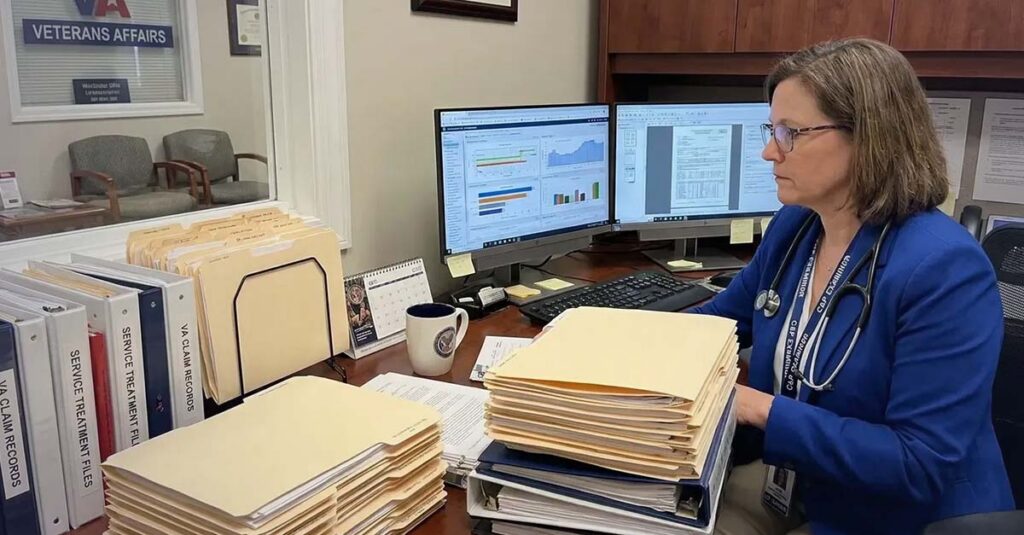
Per VA guidance, the Compensation and Pension (C&P) examiner receives the claims file before the examination appointment. They review service treatment records, VA medical records, and any private medical records present in the file. Preliminary impressions are formed based on that review. The examination itself supplements and confirms those impressions rather than beginning without context.
The completeness of the records in the file before the examination determines what questions the examiner is tasked with addressing — and how those questions are framed.

How Incomplete Records Affect the Examination
When records retrieval through a 21-0845 produces partial documentation, the examiner sees a treatment pattern that may not reflect the true continuity of the veteran’s condition. If primary care records documenting consistent symptom complaints over five years were never retrieved, the examiner sees only records from specialist visits. A veteran’s reported level of ongoing functional limitation may appear inconsistent with the treatment pattern visible in the file. That inconsistency is noted in the examiner’s report and may affect how the condition is rated.
When Comprehensive Records Support the Examination
When complete records are present before the examination — comprehensive treatment history, consistent symptom documentation, imaging studies, and provider notes addressing functional limitations — the examiner’s task is to document current severity against an established evidentiary record rather than to assess whether the condition exists or has been ongoing. Examinations in these circumstances are typically more focused and produce reports that align with the existing evidentiary record.
The role of thorough DBQ evaluations and medical documentation in ensuring the VA has an accurate, complete picture of a veteran’s condition before and during the C&P process directly affects how examinations proceed and how conditions are rated.
REE Medical and Independent Medical Documentation
The post-submission phase of VA Form 21-0845 involves multiple parties that veterans have no direct visibility into: records coordinators working through backlogs, providers who may not respond, documents that may be misfiled, and authorization windows that close while claims remain unresolved.
REE Medical coordinates access to independent, licensed healthcare professionals who complete VA Disability Benefits Questionnaires (DBQs) and objective medical evaluations. These are the standardized medical documents the VA uses as part of its evaluation process. REE Medical’s providers are familiar with VA documentation formats and the evidence standards associated with different diagnostic codes and rating criteria.
REE Medical does not prepare, present, or submit VA disability claims and does not provide legal or representational services. The focus is on ensuring that a veteran’s medical history is clearly and accurately represented through complete, objective, VA-compliant clinical documentation — documentation that enters the claims file through direct submission rather than through the multi-party retrieval chain that authorization alone depends on.
Veterans can learn more about coordinating independent medical evaluations by scheduling a complimentary consultation with REE Medical.
The Importance of Timing in Your 21-0845
The timing of a 21-0845 submission relative to claim filing affects how quickly evidence gathering can begin. Submitting the form with the initial claim application allows records requests to begin as soon as the claim is established in VBMS. Waiting for the VA to issue a request for authorization adds 30–45 days before any records requests go out — and then another 60–90 days for records retrieval. That is a preventable delay of several months.
Fully Developed Claims and Authorization
A Fully Developed Claim (FDC) signals to the VA that all evidence has already been gathered and submitted, allowing the claim to proceed directly to rating without a separate evidence-gathering phase. Including a 21-0845 with an FDC as a precaution — indicating that if the VA identifies any evidence gaps, authorization to request additional records is on file — is an option. Per VA policy, if the VA uses the authorization to request records, the claim is no longer processed under FDC procedures and the expedited pathway no longer applies.

Supplemental Claims
When a supplemental claim is supported by records submitted directly, a new 21-0845 may not be necessary. If the supplemental claim involves ongoing treatment that the VA should request, submitting a new authorization with the supplemental claim — rather than waiting for the VA to request one — avoids a one-month processing delay before records retrieval begins.
Appeals and Authorization Refresh
Appeals can remain pending for 18 months or longer. An authorization that was current when the appeal was filed may have expired by the time the Board of Veterans Appeals schedules a hearing. If the Board identifies a need for updated medical records close to a hearing date, an expired authorization creates a compressed timeline — records cannot be requested without a new form, hearings may need to be rescheduled, and months of delay follow.
For pending appeals approaching the one-year mark from the most recent 21-0845 submission, a fresh authorization submitted proactively — with a cover letter referencing the appeal number and explaining the submission is an update — prevents this scenario.

Final Thoughts
VA Form 21-0845 initiates a process that veterans rarely have full visibility into. Records requests fail silently. Authorizations expire without notification. Claims move forward based on whatever evidence is present when the file is reviewed — not necessarily the complete evidentiary picture the veteran intended to provide.
Understanding VA disability ratings and the evidence standards that determine them is foundational to understanding why records completeness matters. The medical documentation in the claims file at the time of review is the evidence the VA acts on. Records that were never retrieved are not considered.
Veterans whose claims involve complex medical histories, treatment across multiple healthcare systems, or long processing timelines face the greatest risk that a 21-0845 authorization alone will produce incomplete records. Monitoring records retrieval status, submitting critical evidence directly, tracking authorization expiration dates, and refreshing authorizations proactively for long-pending claims and appeals are all elements of managing the post-submission process effectively.
VA Form 21-0845 is the beginning of evidence gathering, not the conclusion. What happens after submission — across multiple parties, processing queues, and months of administrative handling — determines the evidentiary foundation on which a rating decision is made.
DISCLAIMER: REE Medical, LLC is not a Veterans Service Organization (VSO) or a law firm and is not affiliated with the U.S. Veterans Administration (“VA”). Results are not guaranteed, and REE Medical, LLC makes no promises. REE Medical’s staff does not provide medical advice or legal advice, and REE Medical is not a law firm. Any information discussed, such as, but not limited to, the likely chance of an increase or service connection, estimated benefit amounts, and potential new ratings, is solely based on past client generalizations and not specific to any one patient. The doctor has the right to reject and/or refuse to complete a Veteran’s Disability Benefit Questionnaire if they feel the Veteran is not being truthful. The Veteran’s Administration is the only agency that can make a determination regarding whether or not a Veteran will receive an increase in their service-connected disabilities or make a decision on whether or not a disability will be considered service-connected. This business is not sponsored by, or affiliated with, the United States Department of Veterans Affairs, any State Department of Military and Veterans Affairs, or any other federally chartered veterans service organization.