

VA Supplemental Claim: How the Evidence Review Process Works
Introduction
A VA Supplemental Claim is one of three decision review options for Veterans who disagree with a VA decision. According to the VA, a Supplemental Claim allows a Veteran to add new evidence that is relevant to a case or to identify new evidence for review. The VA also lists a request for review based on a change in law, such as the PACT Act, as a basis for a Supplemental Claim. Most coverage of this option centers on eligibility and general processing times. This article covers a narrower question: how the VA reviews evidence while a Supplemental Claim is in progress, and how VA regulations define the terms “new” and “relevant.”
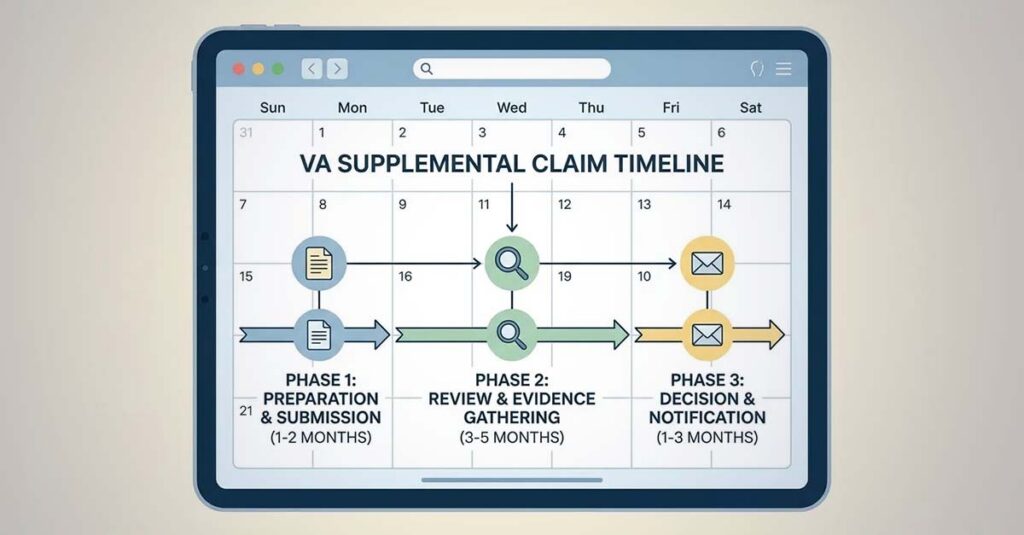
The VA’s review system was restructured under the Appeals Modernization Act. According to the VA Office of Inspector General, the Act established three review lanes: a direct appeal to the Board of Veterans’ Appeals, a higher-level review by a senior technical expert in which no new evidence may be presented, and a Supplemental Claim. The same report notes that higher-level reviews and Supplemental Claims each have a completion goal of an average of 125 days. A goal is not a prediction for any individual case, and timing depends on the evidence in the record and on whether the VA gathers additional information.
Understanding common reasons VA claims are denied provides context for why an earlier decision may have been reached. This article describes the process using VA sources and federal regulations. It is educational and does not advise on any individual case.
TL;DR
- According to the VA, a Supplemental Claim is a decision review option that allows new and relevant evidence to be added to a case.
- Under 38 CFR 3.2501, new evidence is evidence not previously part of the actual record before agency adjudicators, and relevant evidence is information that tends to prove or disprove a matter at issue in a claim.
- The regulation also states that relevant evidence includes evidence that raises a theory of entitlement that was not previously addressed.
- Under 38 CFR 3.2500, effective date rules differ depending on whether review options are pursued continuously within one year of a decision.
- The VA’s decision depends on the specific facts and evidence in each case.

What a Supplemental Claim Covers
The VA describes three decision review options for Veterans who disagree with a decision: a Supplemental Claim, a Higher-Level Review, and a Board Appeal. The VA’s page on choosing a decision review option outlines how the three differ, and its decision reviews page provides an overview of each.
A Supplemental Claim is the option associated with new evidence. A Higher-Level Review is described differently. According to the VA, a higher-level reviewer takes a new look at the case, and the VA’s Higher-Level Review page states that the reviewer will determine whether an error or a difference of opinion changes the decision. New evidence cannot be submitted with that option. A Board Appeal places the case before a Veterans Law Judge at the Board of Veterans’ Appeals.
The process is sometimes described as “reopening” a denied claim. VA regulations do not describe it as a clean slate. The earlier record remains part of the file, and the Supplemental Claim is reviewed in light of the prior decision. Under 38 CFR 3.2501, when new and relevant evidence is presented or secured, the VA readjudicates the claim by taking into consideration all of the evidence of record. When it is not, the regulation provides for a decision stating that the evidence is insufficient to readjudicate. The supplemental claim therefore turns on what the new evidence adds to a record that already exists.
The VA also distinguishes this option from a claim for a condition that has worsened. Per VA guidance on rating reviews, an increased disability compensation claim addresses a service-connected condition that has gotten worse. Further background on that process is available in this explanation of a rating increase request.
How Review Options Are Connected
The decision review options are not separate tracks. They are linked through the continuous pursuit rules in 38 CFR 3.2500. Paragraph (a) of that section describes the reviews available within one year of a notice of decision. A Supplemental Claim may also be received after that period, but the effective date consequences differ.
The regulation’s effective date provisions explain why the one-year mark matters. Under 38 CFR 3.2500(h)(1), if a claimant continuously pursues an issue by timely filing any of the available review options in succession within one year of the issuance of the decision, the effective date is fixed according to the date of receipt of the initial claim or the date entitlement arose, whichever is later. Under paragraph (h)(2), for Supplemental Claims received more than one year after the date the agency of original jurisdiction issues notice of a decision, the effective date is fixed according to the date entitlement arose, but not earlier than the date the Supplemental Claim was received.
The regulation also states that where the VA receives a Supplemental Claim application after the one-year period expires, continuous pursuit is broken unless the VA grants an extension for good cause under 38 CFR 3.109(b). Board of Veterans’ Appeals decisions describe the same principle. As one Board decision puts it, a continuously pursued claim is considered filed as of the date of the first claim in the chain, not the date the most recent request for review was received. These provisions describe how the VA assigns effective dates. They do not recommend a course of action.
The regulation also addresses concurrent reviews. Section 3.2500 contains limits on pursuing more than one review option for the same issue at the same time. The VA’s decision review pages describe how each option is selected, and the details of an individual case depend on the decision under review.
How the VA Defines New and Relevant Evidence
The two terms have specific regulatory definitions. Per 38 CFR 3.2501(a)(1), new evidence is evidence not previously part of the actual record before agency adjudicators. Relevant evidence is information that tends to prove or disprove a matter at issue in a claim. The regulation adds that relevant evidence includes evidence that raises a theory of entitlement that was not previously addressed. The same paragraph states that the new and relevant standard will not impose a higher evidentiary threshold than the previous new and material evidence standard.
Board of Veterans’ Appeals decisions restate these definitions. In one Board decision, the Board described that a claimant may request readjudication of a previously denied claim if new and relevant evidence is presented or secured, and then restated the definitions from the regulation.
The distinction between the two terms reflects how the VA reviews evidence:
- New: Whether the information was already part of the record before the VA’s earlier decision.
- Relevant: Whether the information relates to a matter the claim actually involves.
Evidence can meet one definition and not the other. A document already in the record before the earlier decision is not new, even if it is relevant. A document that is new but unrelated to any matter at issue is not relevant. The VA reviews each submission on its own facts.
What a “matter at issue” means depends on the earlier decision. A claim denied for lack of a current diagnosis involves a different question than a claim denied for lack of a link to service, and both differ from a claim where a rating percentage was assigned. For service connection, the VA’s evidence guidance describes the elements it generally reviews: a current disability, an event, injury, or disease in service, and a link between the two. For ratings, the VA applies 38 CFR Part 4, the Schedule for Rating Disabilities, which contains criteria for each diagnostic code. The importance of medical evidence in VA disability decisions is largely tied to these questions.
Evidence Review During a Supplemental Claim
The VA describes a sequence of steps after a claim is received. According to the VA’s explanation of what a claim status means, one step is evidence gathering, during which the VA reviews the claim and checks that it has the evidence and information needed. The VA’s page on what happens after a claim is filed describes the same stage. A VA News article explains that the Claim Status Tool shows the disability claims process in eight steps.
The regulation addresses how evidence is treated during this process. Under 38 CFR 3.2501, new and relevant evidence received before the VA issues its decision on a Supplemental Claim is considered as having been filed with the supplemental claim application. The regulation also directs the VA to consider VA treatment records reasonably identified by the claimant and evidence received after the VA issued notice of a decision while the evidentiary record was closed, when determining whether new and relevant evidence has been presented or secured.
The VA’s Claims Status Tool FAQ states that new evidence can be uploaded through the tool. Evidence submitted online is one of several routes the VA describes. The VA’s evidence upload page explains that evidence may include supporting documents, such as medical test results and doctor’s reports.
Under 38 CFR 3.2501, new and relevant evidence received before the VA issues its decision on a Supplemental Claim is considered as having been filed with the application, and the regulation separately addresses evidence received after notice of a decision. Because the VA’s decision rests on the record, the content and timing of what is in the file can affect what a reviewer sees. REE Medical does not advise Veterans on when to submit evidence. This description reflects the VA’s published materials only.
Forms and Submission Methods
The VA publishes the form used for this review option: the Decision Review Request: Supplemental Claim, VA Form 20-0995. A copy of the form is available through the VA, and the VA’s Supplemental Claim page describes how applications are submitted. According to VA materials on the form, the VA’s goal for completing Supplemental Claims is 125 days, and a Supplemental Claim and supporting evidence are submitted within one year of the date on a VA decision to preserve continuous pursuit.
When private medical records are involved, the VA uses an authorization process. VA Form 21-4142 is the authorization to disclose information to the VA, and VA Form 21-4142a is the companion form for providers’ information. Additional background is available in REE Medical’s resources on VA Form 21-4142 and VA Form 21-4142a. The VA’s page on private medical evidence states that the VA encourages Veterans to submit their private medical records for consideration during the processing of their benefits claims.
Under 38 CFR 3.159, the VA has a duty to assist in developing evidence in certain circumstances. Section 3.159(c) describes the VA’s efforts to obtain relevant records from federal agencies and, in some situations, from private providers, when the claimant adequately identifies them. Section 3.159(c)(4) describes when the VA provides a medical examination or obtains a medical opinion, which applies when the record lacks sufficient competent medical evidence to decide the claim but contains competent lay or medical evidence of a current diagnosed disability or persistent or recurrent symptoms, establishes an in-service event, injury, or disease, and indicates that the disability or symptoms may be associated with that event or with another service-connected disability. The text of 38 CFR 3.159 sets out these provisions in full.

Types of Evidence the VA Reviews
The VA’s evidence guidance describes several categories. Medical evidence includes treatment records, test results, and clinical findings. Lay evidence is described in 38 CFR 3.159(a)(2) as evidence that does not require specialized education, training, or experience, and it is competent when it comes from a person with knowledge of facts or circumstances who conveys matters that can be observed and described by a lay person. A statement from a fellow service member describing an event is one example of lay evidence.
Competent medical evidence has a separate definition. Per 38 CFR 3.159(a)(1), it means evidence provided by a person qualified through education, training, or experience to offer medical diagnoses, statements, or opinions. The regulation treats medical and lay evidence differently, and the VA reviews both together with the rest of the record.
Medical evidence also arises from different sources:
- Treatment records created by clinicians who care for a Veteran.
- VA Compensation & Pension (C&P) examinations, which the VA may schedule to review a condition.
- Independent medical evaluations completed by licensed clinicians outside the treatment relationship.
- Disability Benefits Questionnaires (DBQs), standardized forms that record findings for specific conditions.
VHA Directive 1134 describes a DBQ as a standardized VA documentation tool used to provide pertinent medical information in support of the disability compensation process. The VA’s own policy on C&P examinations is described in VHA’s directive on compensation and pension disability examinations, which states that VHA provides a C&P examination, medical opinion, or both when requested by the Veterans Benefits Administration.
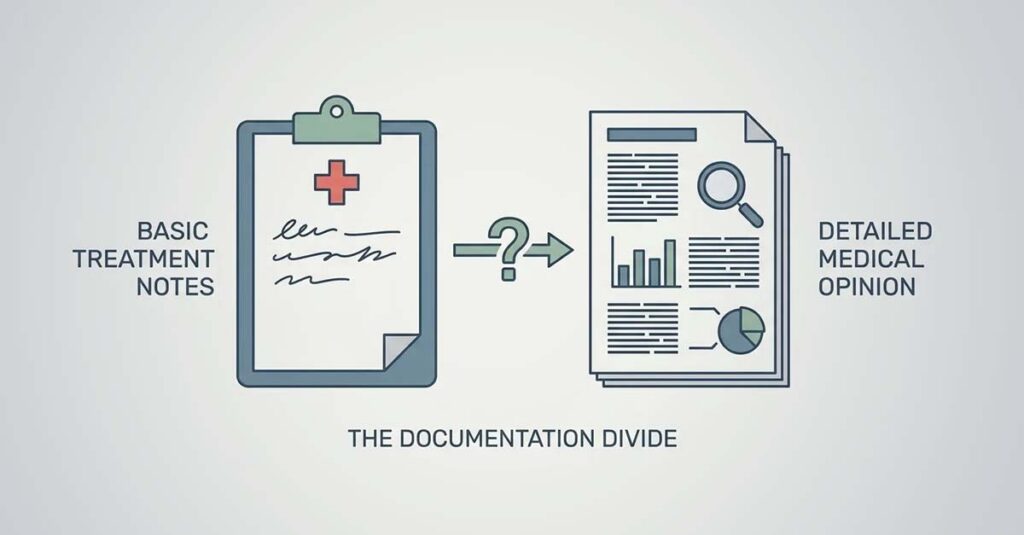
Treatment records and claim-related evaluations serve different purposes. Treatment records document care and clinical findings as they occur. Independent evaluations and DBQs are structured around the criteria the VA applies. Comprehensive medical documentation allows the VA to assess the full scope of a Veteran’s condition, including aspects that vary over time. More on these categories is available in this overview of what evidence a disability claim involves.
Illustrative Examples
The following hypothetical examples illustrate how the VA’s terminology can apply. They are not predictions, and the VA’s decision depends on the specific facts and evidence in each case.
In the first example, a Veteran’s earlier decision stated that the record did not contain a medical opinion addressing a link between a current condition and service. A later submission includes a new independent medical opinion. Under the regulation, the opinion is new because it was not previously part of the record. It is relevant because it relates to the matter the earlier decision addressed. The VA then reviews it together with the rest of the record.
In the second example, a Veteran submits additional treatment notes that repeat information already in the file. The notes may be new documents, but their content may not add information on any matter at issue. The VA reviews the content, not just the date, when it determines whether evidence is new and relevant.
In the third example, a Veteran identifies a theory of entitlement that the prior decision did not address, such as a secondary relationship between two conditions. Under 38 CFR 3.2501(a)(1), relevant evidence includes evidence that raises a theory of entitlement that was not previously addressed. The VA reviews how the new theory relates to the record.

Claim Status and Processing Time
The VA offers several ways to follow a case. According to the VA, status can be reviewed through its online tools, and the Claims Status Tool FAQ describes the status labels and how evidence can be uploaded. The VA states that a claim status tells where a claim is in the review process. Status labels describe the broad stage of review rather than every internal action.
Processing time varies. The VA’s published goal for supplemental claims and higher-level reviews is an average of 125 days, per VA News and the VA Office of Inspector General report. The VA publishes current average processing figures on its decision reviews pages. Because these are averages across many claims, they do not describe any individual case. Several factors can affect timing, including claim complexity, VA workload, and whether the VA schedules an examination or requests additional records.
The VA’s older description of the process notes that claims can move between phases. Per the VA’s compensation process page, additional evidence needs can return a claim to the gathering of evidence phase. A single status label at a point in time therefore does not predict the full length of a review.
Options After a Decision
According to the VA, Veterans who disagree with a Supplemental Claim decision can choose among the decision review options again. These are a Higher-Level Review of the decision, a Board Appeal, or another Supplemental Claim with new and relevant evidence. The VA’s decision reviews page describes each option. Effective date consequences depend on the timing rules in 38 CFR 3.2500, including whether a review option is received within one year of the notice of decision. More on how these options relate is available in this overview of how a low VA rating can be challenged.
The VA’s materials describe these as choices belonging to the Veteran. REE Medical does not advise on which option applies or when to use it. Veterans with questions about decision review options can contact the VA, an accredited Veterans Service Organization representative, an accredited attorney, or an accredited claims agent. REE Medical is not a VSO or a law firm and does not provide legal or representational services.

Medical Documentation and REE Medical’s Role
REE Medical coordinates independent medical evaluations and DBQs completed by licensed healthcare professionals. REE Medical staff connect Veterans with independent, licensed providers whose backgrounds align with the condition being evaluated. The evaluations are completed by licensed clinicians in a VA-standardized format, and they are medical documents that the VA may review as part of the record.
REE Medical does not prepare, present, or submit VA disability claims. REE Medical also does not advise on VA forms, filings, or decision review options. REE Medical partners with independent, trusted organizations that can provide additional specialized documentation if needed. Veterans can learn more about how independent medical documentation is coordinated by contacting REE Medical for a complimentary, informational consultation.
Frequently Asked Questions
How long does a VA Supplemental Claim take?
According to the VA, its goal is to complete Supplemental Claims in an average of 125 days. Per the VA Office of Inspector General, higher-level reviews and supplemental claims each carry that completion goal. The VA publishes current averages on its decision reviews pages. These are estimates, not guarantees, and timing varies with claim complexity, workload, and whether the VA schedules exams or requests records.
Can Supplemental Claim status be checked online?
Per VA guidance, the Claims Status Tool shows where a claim is in the review process, and the VA’s status guide explains each term. The VA’s Claims Status Tool FAQ states that new evidence can be uploaded through the tool. Status labels describe the broad stage of review and do not describe every internal action.
What options exist after a Supplemental Claim decision?
According to the VA, Veterans who disagree with a decision can choose among a Supplemental Claim, a Higher-Level Review, and a Board Appeal. The VA’s Higher-Level Review page states that the reviewer determines whether an error or a difference of opinion changes the decision, and that no new evidence can be submitted with that option. Under 38 CFR 3.2500, effective date rules differ depending on whether review options are pursued within one year of the notice of decision.
Is an attorney or VSO required for a Supplemental Claim?
According to the VA, Veterans can apply on their own, and accredited attorneys, claims agents, and Veterans Service Organization representatives can also assist with decision review requests. The VA’s decision depends on the specific facts and evidence in each case. REE Medical is not a VSO or a law firm and does not provide legal or representational services.
What is the difference between new and relevant evidence?
Per 38 CFR 3.2501(a)(1), new evidence is evidence not previously part of the actual record before agency adjudicators, and relevant evidence is information that tends to prove or disprove a matter at issue in a claim. Relevant evidence also includes evidence that raises a theory of entitlement that was not previously addressed. The VA reviews each submission against the record that already exists.
Final Thoughts
A Supplemental Claim is one of the VA’s three decision review options, and it is generally associated with the review of new and relevant evidence or a change in law. Federal regulations define both terms, and VA materials describe the review process as a sequence of steps in which evidence is gathered and reviewed before a decision. Effective date rules under 38 CFR 3.2500 connect the review options to one another through the one-year continuous pursuit provision. The VA’s decision depends on the specific facts and evidence in each case.
At REE Medical, we believe every Veteran deserves access to clear, accurate medical documentation that reflects the full impact of their health conditions. Veterans can learn more about how independent medical documentation is coordinated by contacting REE Medical for a complimentary, informational consultation.
DISCLAIMER: REE Medical, LLC is not a Veterans Service Organization (VSO) or a law firm and is not affiliated with the U.S. Veterans Administration (“VA”). Results are not guaranteed, and REE Medical, LLC makes no promises. REE Medical’s staff does not provide medical advice or legal advice, and REE Medical is not a law firm. Any information discussed, such as, but not limited to, the likely chance of an increase or service connection, estimated benefit amounts, and potential new ratings, is solely based on past client generalizations and not specific to any one patient. The doctor has the right to reject and/or refuse to complete a Veteran’s Disability Benefit Questionnaire if they feel the Veteran is not being truthful. The Veteran’s Administration is the only agency that can make a determination regarding whether or not a Veteran will receive an increase in their service-connected disabilities or make a decision on whether or not a disability will be considered service-connected. This business is not sponsored by, or affiliated with, the United States Department of Veterans Affairs, any State Department of Military and Veterans Affairs, or any other federally chartered Veterans service organization.