


Benefits Delivery at Discharge Program: Eligibility and VA Exam Basics
The Benefits Delivery at Discharge program lets eligible service members submit a disability claim before leaving the military. According to the VA’s BDD requirements, full-time active-duty service members with a known separation date can submit a claim between 180 and 90 days before separation. They must be available for VA exams during the 45 days after submission. The VA states that the program may speed up the claim decision process. It does not guarantee a decision or a payment at discharge.
A BDD claim opens a short period in which exams, records, and paperwork move on a schedule the VA sets. The VA bases its decisions on the evidence in the record.
A resource on a strong post-service start describes why the months around separation carry so many decisions. The sections below describe the program’s mechanics, how the VA uses exams in a BDD claim, how exam findings fit into the full record, how the VA’s forms document symptoms, and what happens to medical records after separation.
TL;DR: The Short Version
- The VA describes a window of 180 to 90 days before separation for the BDD program, with availability for VA exams required during the 45 days after submission, per the VA’s BDD requirements.
- A completed Separation Health Assessment, Part A, accompanies the application. For online submissions, the VA states that it obtains service treatment records, as the VA’s BDD page explains.
- The VA’s claim exam guidance describes an exam as one source of information, and the VA’s disability rating guidance states that ratings rest on the evidence in the record.
- According to the VA, the provider writes an exam report and sends it to the VA, which reviews all of the evidence in the file.
- A rating decision can be reviewed. Review options appear in the VA’s decision review guidance, and later worsening is a separate question.
What the BDD Program Asks of Eligible Service Members
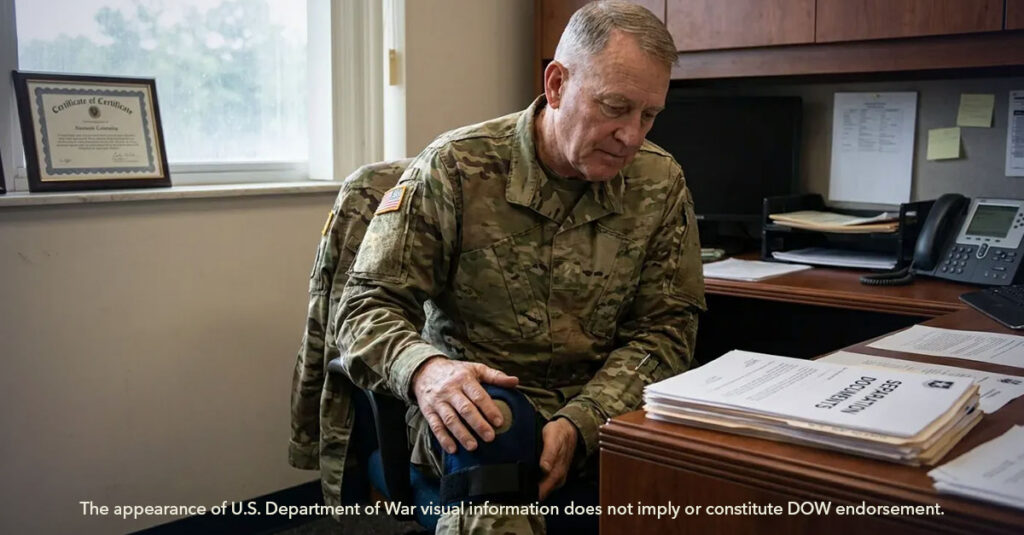
The Benefits Delivery at Discharge program has defined mechanics. According to the VA’s pre-discharge claim page, eligibility depends on three conditions. The service member is on full-time active duty, including members of the National Guard, Reserve, or Coast Guard. The service member has a known separation date that is 180 to 90 days away. And the service member is available for VA exams during the 45 days after the claim is submitted.
The VA states that a completed Separation Health Assessment, Part A Self-Assessment form accompanies the application. Service treatment records are handled differently by route. For a BDD claim submitted online, the VA states that it obtains the service treatment records. Other routes call for a copy of those records to accompany the claim. In both cases, the records form a baseline for what the VA reviews.
According to the VA, service members stationed in the U.S. must be available for a VA medical exam for 45 days from the date they apply and must finish all phases of the VA and Department of Defense medical separation examination process before release from the military. Service members stationed overseas can start a claim at a BDD office or submit it online or with an accredited representative. The exact steps are set by the VA, and its instructions control.
Eligibility points from the VA’s BDD page
- Full-time active-duty status
- A known separation date, 180 to 90 days away
- Availability for VA exams during the 45 days after submission
- A completed Separation Health Assessment, Part A
- A claim that does not require special handling
Special handling excludes some situations from the program. The VA lists these situations: case management for a serious injury or illness, terminal illness, waiting for discharge while being treated at a VA hospital or military treatment facility, waiting for a Character of Discharge determination, and an inability to attend a VA exam during the 45-day period. Service members who are wounded, injured, or ill and unable to perform duties are referred by a doctor to the Integrated Disability Evaluation System instead.
With fewer than 90 days left, the BDD program is not available. The VA states that a standard disability claim can still be submitted before separation, along with the supporting evidence on hand. According to the VA, conditions can be added to a BDD claim until day 90 before the expected discharge date. Conditions added later may not be processed until after discharge.
Records matter at every stage. A discussion of claims without complete medical records outlines general options when records are missing. It does not change the BDD timeline, which the VA sets.
According to the VA, the BDD program may help speed up the claim decision process. The VA does not state that earlier submission produces a particular rating, and no outcome follows from timing alone.
How the VA Uses Exams in a BDD Claim
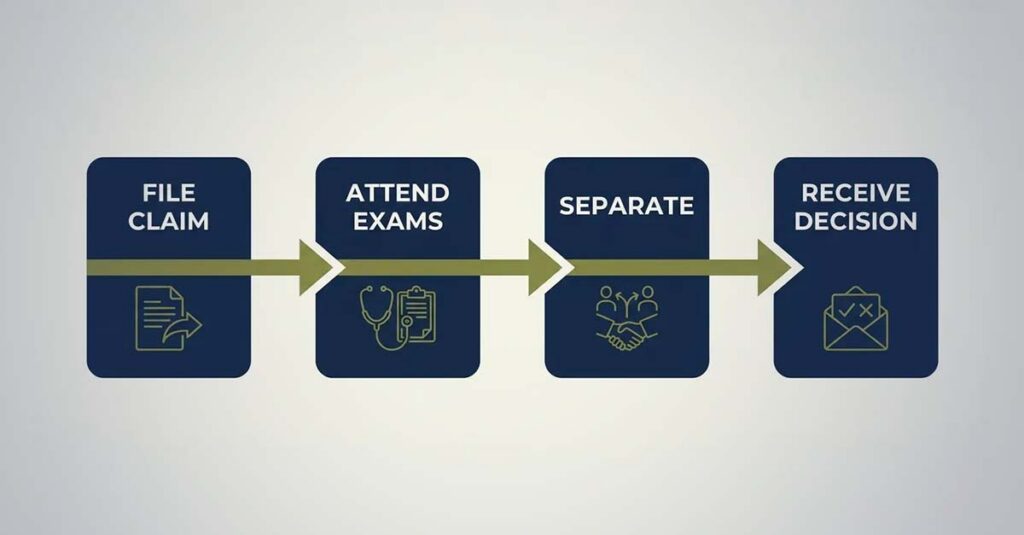
According to the VA’s claim exam guidance, the VA schedules an exam when it needs more information to decide a claim, and the provider writes an exam report and sends it to the VA, which reviews all of the evidence in the file. The examiner assesses the condition, and the VA decides the claim. A resource on common VA disability misconceptions addresses some of the beliefs about the process.
How Exam Findings Fit Into the Full Record
An exam is one source among many. The VA’s disability rating guidance states that the VA bases a rating on the evidence in the record, such as a doctor’s report or medical test results, the results of a VA claim exam when the VA determines one is needed, and information from sources such as federal agencies. A disability rating is a percentage representing how much a disability decreases overall health and ability to function.
The first decision from the Benefits Delivery at Discharge program reflects the evidence in the record at that time. According to the VA, a Veteran whose condition has gotten worse can file a claim for increased disability compensation, and a Veteran who disagrees with a decision can use one of the VA’s decision review options. Many factors shape a decision, and the VA’s decision depends on the specific facts and evidence in each case.
Two situations are worth separating. Disagreement with the original decision is one, and later worsening of the condition is another. The VA’s decision review options address disagreement with a decision. A Supplemental Claim applies when there is new and relevant evidence, a Higher-Level Review does not accept new evidence, and a Board appeal goes to a Veterans Law Judge. A claim for increase addresses a condition that has worsened since the rating, and the VA’s claim guidance describes how claims begin.
Background on review options is available in this overview of how a low VA rating can be challenged. According to the VA, accredited representatives are available to help with decision reviews.
The record continues to change after a decision. Treatment, new diagnoses, and changes in severity all generate documents, and the VA reviews them when a new claim or review begins. A first rating therefore describes a condition at one point in time, and the passage of time can alter the evidence in either direction.

How the VA’s Forms Document Symptoms
The Disability Benefits Questionnaire (DBQ) framework shows what kinds of information the VA’s forms collect. The VA lists the forms it publishes on its public DBQ page. Background on how DBQs support documentation describes the format. Depending on the condition, forms may ask about frequency, severity, duration, and the effect of a condition on daily functioning and work.
The VA’s exam guidance explains how records reach the claim. According to the VA’s claim exam page, new non-VA medical records are submitted to the VA directly. Records carried to an exam appointment are not thereby submitted to the claim, and an examiner may review them but cannot submit them on a claimant’s behalf.

After Separation, Records Keep Accumulating
The record does not end at discharge. Civilian treatment records document ongoing care and changes in severity. The original decision from the Benefits Delivery at Discharge program reflects the evidence that existed at the time, and later records can show a different picture. The VA reviews the evidence in the record whenever a new claim or review begins.
Several evidence types commonly accumulate after separation:
| Evidence type | What it can show | Typical timing |
| Civilian treatment records | Ongoing care and changes in severity | After each civilian visit |
| Current diagnosis | A condition is present now | At the first civilian appointment for that symptom |
| Medical opinion on service connection | A medical link between the condition and service | After a diagnosis is documented |
For examples of how independent medical opinions are structured, see this overview of what medical opinions include. An opinion on service connection addresses the medical relationship between a condition and service, and the VA decides entitlement.
REE Medical coordinates independent medical evaluations and DBQs completed by licensed healthcare professionals, as described in its services overview.
REE Medical partners with independent, trusted organizations that can provide additional specialized documentation if needed. An independent evaluation does not replace a VA exam the VA requests, and the VA alone decides claims. REE Medical does not prepare, present, or submit VA disability claims and does not provide legal or representational services.
Veterans can learn more about how independent medical documentation is coordinated by contacting REE Medical for a complimentary, informational consultation.
Frequently Asked Questions
What Happens If Fewer Than 90 Days Remain Before Separation?
According to the VA, a service member with fewer than 90 days left on active duty cannot file through the BDD program but can file a standard disability claim before separating, submitting all the supporting evidence on hand.
Can Conditions Be Added to a BDD Claim?
According to the VA’s BDD page, conditions can be added to a BDD claim until day 90 before the expected discharge date, and the VA includes them with the original claim. A condition added with fewer than 90 days left on active duty may not be processed until after discharge. Background on initial and increase claims describes the general process, and the VA’s claim guidance covers the application itself.
Can someone else describe symptoms for a claim?
Under 38 CFR 3.159(a)(2), lay evidence is competent when it comes from a person with knowledge of facts or circumstances who conveys matters that can be observed and described by a lay person. A lay statement is separate from a medical diagnosis or opinion. A resource on an evidence-based VA claim describes how different evidence types relate.
Final Thoughts
According to the VA, the Benefits Delivery at Discharge program allows eligible service members to submit a claim 180 to 90 days before separation, with VA exams scheduled within 45 days of submission. The VA’s own application and appointment instructions govern the process, and the VA’s decision depends on the specific facts and evidence in each case.
For a BDD claim, the exam schedule comes before the discharge date. The process asks a great deal at a demanding time, and a steady pace is reasonable.
The VA’s instructions come first.
Disclosure
DISCLAIMER: REE Medical, LLC is not a Veterans Service Organization (VSO) or a law firm and is not affiliated with the U.S. Veterans Administration (“VA”). Results are not guaranteed, and REE Medical, LLC makes no promises. REE Medical’s staff does not provide medical advice or legal advice, and REE Medical is not a law firm. Any information discussed, such as, but not limited to, the likely chance of an increase or service connection, estimated benefit amounts, and potential new ratings, is solely based on past client generalizations and not specific to any one patient. The doctor has the right to reject and/or refuse to complete a Veteran’s Disability Benefit Questionnaire if they feel the Veteran is not being truthful. The Veteran’s Administration is the only agency that can make a determination regarding whether or not a Veteran will receive an increase in their service-connected disabilities or make a decision on whether or not a disability will be considered service-connected. This business is not sponsored by, or affiliated with, the United States Department of Veterans Affairs, any State Department of Military and Veterans Affairs, or any other federally chartered Veterans service organization.