


VA TERA Presumptive Conditions: Separating Exposure From Entitlement
Searches for VA TERA presumptive conditions often combine two different ideas. TERA stands for toxic exposure risk activity, a term defined in federal law. It is not a separate, universal list of presumptive conditions. The PACT Act contains both presumptive provisions, which treat certain diseases as connected to service when specific requirements are met, and examination and opinion requirements, which apply in a different situation. A TERA memo does not by itself establish service connection or a rating.
The distinction matters because exposure and entitlement are separate questions. Exposure asks what a service member was exposed to, and where and when. Entitlement asks whether the VA will find that a current disability is connected to service. The VA’s PACT Act guide explains how presumptions work, and 38 USC 1168 addresses examinations and medical opinions tied to toxic exposure risk activities.
Neither source describes an automatic outcome. A presumption supplies the link between a condition and service when its requirements are met, and a TERA-based medical opinion addresses individual linkage where the statute applies. The sections below describe what TERA means, how presumptive conditions and locations are organized, how the two frameworks differ, how the VA assigns a rating after service connection, and how medical documentation fits when exposure questions remain.
TL;DR: The Short Version
- TERA means toxic exposure risk activity, a defined statutory term. It is not a separate universal list of presumptive conditions, per 38 USC 1168.
- For a presumptive condition, the VA’s guide states that the service requirements for the presumption must be met, according to the VA’s PACT Act guide.
- A presumption, a TERA medical opinion, and a rating are three separate steps.
- Exposure evidence consists of actual service locations, dates, duties, and records, and the specific rule determines what is required.
- Medical documentation can address a medical question. It does not establish where a Veteran served.

Actual Service and Exposure Evidence
Exposure evidence begins with facts about service: the locations, the dates, the duties performed, and the records that reflect them. The VA’s PACT Act guide lists presumptive exposure locations and time periods for different hazards. A statutory exposure presumption applies when service matches a listed location and period. Individualized TERA evidence concerns activities and exposures that fall outside a presumption or that the VA evaluates under 38 USC 1168.
Questions about VA TERA locations arise. The presumptive location lists in the VA’s guide are organized by hazard, such as burn pits, Agent Orange, and radiation, and each has its own countries or sites and its own dates. Country-level qualifying service does not always require narrowing to base coordinates, so this article does not describe any base perimeter or distance rule. Records that show a service member was in a listed country on a listed date are what the presumption looks for.
Service records, orders, deployment dates, and duty assignments are the usual sources. Personnel records and treatment records add context. A statement describing specific exposures, such as time spent near a burn pit, can add detail. It does not guarantee proof.
Hypothetical example: a service member’s orders show a deployment to a listed country within the qualifying period, and a treatment record documents a respiratory condition. The orders address the exposure question, and the treatment record addresses the diagnosis. The VA then applies the rule for that category, and the example predicts no outcome.
What TERA Actually Stands For, and Why the Name Matters
The statute that uses the term is 38 USC 1168, whose heading refers to medical nexus examinations for toxic exposure risk activities. The statute applies when a Veteran submits a claim for compensation with evidence of a disability and evidence of participation in a toxic exposure risk activity during service, and the evidence is not sufficient to establish service connection. In that situation, the VA is to arrange a medical examination and request a medical opinion on whether it is at least as likely as not that the disability is linked to the toxic exposure risk activity.
The opinion has a defined scope. Under the statute, the health care provider weighs the total potential exposure through all applicable military deployments and the combined effect of all toxic exposure risk activities. The statute contains an exception: it does not apply if the Secretary determines there is no indication of an association between the claimed disability and the activity for which the Veteran submitted evidence.
The statute defines the term by reference to 38 USC 1710. There, a toxic exposure risk activity is any activity that requires a corresponding entry in an exposure tracking record system for the Veteran, or that the Secretary determines qualifies when taking into account what is reasonably prudent to protect the health of Veterans. The definition as written does not name a specific hazard or location.
This is why the VA TERA presumptive conditions label can mislead. The statute governs when the VA arranges an examination and requests a medical opinion. It does not list diseases that are presumed connected. Presumptive diseases come from other provisions, which the next section describes. Searches for VA TERA conditions therefore lead to two distinct bodies of law, and keeping them separate avoids a common source of confusion.
Examples From the VA’s Current Presumptive List
Questions such as “what are the 3 new VA presumptive conditions” reflect a common search pattern, though no fixed set of three is described here. The VA’s PACT Act guide lists many conditions that are presumptive for Gulf War era and post-9/11 Veterans, and it states that the PACT Act added burn pit and other toxic exposure presumptive conditions.
Among the illnesses the VA lists as now presumptive under the PACT Act are chronic rhinitis, chronic sinusitis, and constrictive bronchiolitis or obliterative bronchiolitis. These are examples from the VA’s official list, and they are not the full list. The VA’s list also names other respiratory conditions and several cancers.
Conditions and qualifying service must match the applicable rule. A Veteran with a listed condition who did not serve in a listed location during the listed period has not necessarily met the presumption’s service requirement. A Veteran who served in a listed location but has a condition not on the list is in a different position. Each element is evaluated separately.
Within VA TERA presumptive conditions as discussed online, readers also encounter lists for Agent Orange and radiation. The VA’s guide identifies two Agent Orange presumptive conditions added by the PACT Act: high blood pressure, also called hypertension, and monoclonal gammopathy of undetermined significance (MGUS). Other lists carry other conditions, and none of these lists substitutes for the specific rule.

Location and Date Rules by Hazard
The VA’s guide describes burn pit exposure locations and dates in two groups. The VA states that if a Veteran served in any of these locations and time periods, the VA has determined that exposure to burn pits or other toxins occurred, which it calls a presumption of exposure.
| Group | Time period | Locations listed by the VA |
| First group | On or after August 2, 1990 | Bahrain, Iraq, Kuwait, Oman, Qatar, Saudi Arabia, Somalia, the United Arab Emirates, and the airspace above these locations |
| Second group | On or after September 11, 2001 | Afghanistan, Djibouti, Egypt, Jordan, Lebanon, Syria, Uzbekistan, Yemen, and the airspace above these locations |
The complete list appears in the VA’s PACT Act guide, and it is the source for any particular location. No coordinates and no base opening dates are given here, because the list is organized by country.
Other exposure presumptions follow different rules. The guide lists Agent Orange locations such as parts of Thailand, Laos, Cambodia, Guam, American Samoa, and Johnston Atoll, each with its own dates. Radiation presumptions list specific response efforts. A service member’s location and dates must match the rule that governs the hazard in question. A VA TERA presumptive conditions search that blends these lists can produce an inaccurate picture, so the hazard-specific list is the reliable reference.
TERA Memoranda in an Individual Claim
The statute cited in this article, 38 USC 1168, does not use the term “TERA memorandum.” A document in a claim file that addresses exposure speaks to the exposure question. It does not decide service connection or a rating, and the claim file shows which documents exist.
PACT Act Presumptions and TERA Assessments
Three concepts are often blended. The table below separates them.
| Concept | Meaning | Does not establish by itself |
| PACT Act | Law expanding benefits and care | Every claimed disease is presumptive |
| Disease presumption | An applicable rule can supply service linkage when requirements are met | A specific rating percentage |
| TERA assessment | Individual exposure-related evaluation and medical linkage where applicable | Automatic service connection or a separate universal disease list |
The PACT Act is the law. Per the VA’s PACT Act guide, it expands VA health care and benefits for Veterans exposed to burn pits, Agent Orange, and other toxic substances. A disease presumption is one rule within that framework. A TERA assessment under 38 USC 1168 is a different mechanism for individual linkage.
Readers often look for a PACT Act presumptive conditions list PDF or a PACT Act presumptive conditions list from 2024. The VA’s guide is the current official source, and its contents change as the VA updates it, so a downloaded copy may be out of date. The guide displays a last-updated date (June 2, 2026, at the time of this review), and that date is the reliable indicator of currency.
No source cited here suggests that using one label instead of another causes a denial. A claim is evaluated on its facts under the applicable rules. A mismatch between a condition and the rule that governs it can lead to a denial, but that is a question about the facts and not about a label.

How the VA Assigns a Rating After Service Connection
TERA participation alone does not establish service connection, and it does not assign a percentage. The VA first decides entitlement and then applies the rating criteria for the condition. The VA’s disability rating guidance states that the VA assigns a rating based on the severity of the service-connected condition, using the evidence in the record.
Questions such as how a TERA VA claim percentage is determined have the same answer: the percentage follows the condition’s diagnostic code. Relevant tests and other criteria depend on that code. Respiratory conditions, for example, may be evaluated through pulmonary function testing, but the specific tests and thresholds depend on the diagnostic code and the condition. This article gives no percentage examples for any particular condition, and symptoms alone do not determine every respiratory rating.
A presumptive finding supplies the link to service. The rating then reflects how severe the condition is. A Veteran can be service connected for a presumptive condition and receive a low rating, and severity is a separate question from entitlement. The VA applies the rating schedule to the clinical findings, which are documented through exams and treatment records.
An exam is one source of those findings. The VA’s claim exam guidance explains that the VA schedules one when it needs more information. Results are one part of a record that the VA reviews as a whole.

Evidence Categories When Records Are Incomplete
Records are sometimes incomplete. A TERA-related file may contain several categories of evidence:
- Personnel and treatment records
- Available orders, with actual dates and duties
- Specific firsthand accounts of exposure
- Current medical findings
Under 38 CFR 3.303, the VA reviews all evidence in the record. A lay statement may add detail about exposures that records do not capture, but it does not guarantee proof, and it does not establish medical causation. Hypothetical example: a Veteran’s orders confirm a deployment, and a statement describes working near a burn pit most days. The orders address presence, the statement addresses duties, and a clinician addresses the medical question. Each document answers a different question.
When service records are incomplete, the VA’s process may involve its own record requests. The VA’s filing guidance describes how claims begin and what evidence supports them. A resource on lost or missing service files discusses how gaps arise.
The outcome depends on the record, and the VA decides. Nor does equal evidence automatically cure a factual gap. The outcome depends on the record, and the VA decides.
Medical Documentation and Unresolved Exposure Questions
A clinician’s assessment can address a medical question about a documented exposure history. REE Medical coordinates independent medical evaluations and DBQs completed by licensed healthcare professionals through its independent evaluation and documentation services. The services connect Veterans with licensed, independent clinicians who complete evaluations and Disability Benefits Questionnaires.
A medical assessment can address a documented exposure history and other possible causes. It cannot establish where a Veteran served. Under 38 USC 1168, the VA’s own opinion process weighs total potential exposure through all applicable deployments. A private assessment is a separate document, weighed under the same principles as any opinion. The Court of Appeals for Veterans Claims addressed those principles in Nieves-Rodriguez, which indicates that an opinion’s value rests on its reasoning and factual accuracy and not on its source.
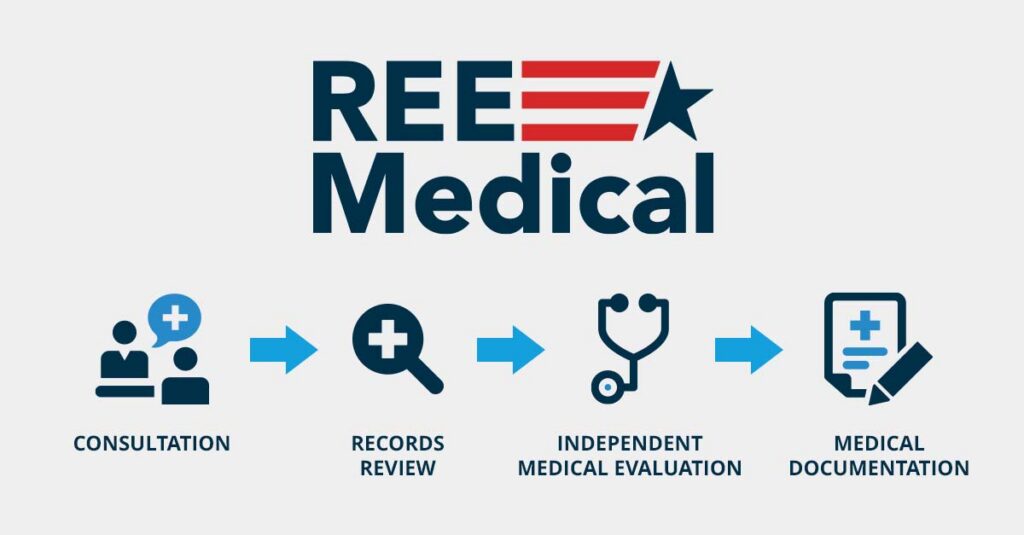
According to its services page, the process begins with a complimentary consultation, followed by access to a licensed independent provider and documentation completed by that provider.
REE Medical partners with independent, trusted organizations that can provide additional specialized documentation if needed. The VA alone decides claims. REE Medical does not prepare, present, or submit VA disability claims and does not provide legal or representational services.
Veterans can learn more about how independent medical documentation is coordinated by contacting REE Medical for a complimentary, informational consultation.
Frequently Asked Questions
Can a Veteran who is already service connected seek benefits for another condition?
Yes. A Veteran can seek benefits for another condition while already rated. Whether a new claim or a review applies depends on whether the same issue was previously decided, as the VA’s filing guidance and the VA’s decision review options describe. 38 CFR 3.327 addresses reexaminations, and no existing rating is guaranteed to be free from review.
How long does a TERA-related claim take to process?
According to the VA’s claim process page, the time depends on the type of claim, the number and complexity of the disabilities claimed, and how long it takes to collect the evidence. The VA’s claim status tool shows where a claim stands, and additional evidence can send a claim back to the evidence gathering step. Faster processing is not guaranteed.
What Types of Accredited Representation Does the VA Describe?
According to the VA’s accredited representative guidance, Veterans can work with VSO representatives, accredited attorneys, and accredited claims agents, and the guidance explains the fee rules that apply. REE Medical coordinates medical documentation and is not an accredited representative.
What if exposure occurred outside a presumptive location?
A presumptive location is not the only pathway. Service connection can also be considered under the general rules in 38 CFR 3.303 and, where the statute applies, under 38 USC 1168. The VA’s PACT Act guide lists the current presumptive locations, and no future additions are promised.
Can a Veteran receive both VA health care and disability compensation for a TERA condition?
Health care eligibility and disability compensation are separate determinations. The VA’s PACT Act guide describes PACT Act health care eligibility separately from disability benefits. Compensation requires an approved claim and the rating rules in the VA’s disability rating guidance. No TERA finding is described as producing monthly compensation, free care, or Community Care authorization unconditionally.
Final Thoughts
Exposure and entitlement are different questions. A Veteran’s records show where service occurred and what activities were involved, and the VA applies the presumption, the TERA statute, or the general rules to those facts. A clinician addresses the medical question where one remains. The VA’s decision depends on the specific facts and evidence in each case.
Disclosure
DISCLAIMER: REE Medical, LLC is not a Veterans Service Organization (VSO) or a law firm and is not affiliated with the U.S. Veterans Administration (“VA”). Results are not guaranteed, and REE Medical, LLC makes no promises. REE Medical’s staff does not provide medical advice or legal advice, and REE Medical is not a law firm. Any information discussed, such as, but not limited to, the likely chance of an increase or service connection, estimated benefit amounts, and potential new ratings, is solely based on past client generalizations and not specific to any one patient. The doctor has the right to reject and/or refuse to complete a Veteran’s Disability Benefit Questionnaire if they feel the Veteran is not being truthful. The Veteran’s Administration is the only agency that can make a determination regarding whether or not a Veteran will receive an increase in their service-connected disabilities or make a decision on whether or not a disability will be considered service-connected. This business is not sponsored by, or affiliated with, the United States Department of Veterans Affairs, any State Department of Military and Veterans Affairs, or any other federally chartered Veterans service organization.