
Veterans Disability Benefits: A Comprehensive Informational Overview
The landscape of veterans disability benefits has undergone dramatic changes in recent years, with Post-9/11 veterans experiencing a significant increase in service-connected disability rates from about 18% in 2008 to 31% in 2022. This surge reflects both improved recognition of service-related conditions and expanded access to benefits through legislative changes like the PACT Act. Understanding how to navigate this complex system can help veterans access the financial support and healthcare services available to them.
Table of Contents
- Understanding Eligibility and Rights
- The VA Claims Process
- The Benefits Package
- Specialized Medical Conditions
- How REE Medical Supports Veterans
Key Takeaways
- Service connection requires demonstrating that your condition links to military service through direct, secondary, or presumptive pathways
- VA disability ratings use complex mathematics from 0-100% that don’t simply add together
- Intent to File preserves an effective date for up to one year, potentially securing retroactive benefits
- The Appeals Modernization Act offers three distinct appeal paths with different timelines and evidence requirements
- Beyond monthly compensation, veterans can access VR&E benefits, dependent allowances, and state-specific programs
- Mental health claims and sleep disorders require specialized documentation approaches
- Recent policy changes like the PACT Act have expanded presumptive conditions for toxic exposure claims

Understanding Eligibility and Rights
Establishing eligibility for veterans disability benefits centers on proving service connection—the fundamental link between a current medical condition and military service. This process involves understanding three distinct pathways: direct service connection (where military service caused or aggravated a condition), secondary conditions (disabilities that developed because of an already service-connected condition), and presumptive conditions (automatically assumed to be service-related based on specific service locations or exposures). The VA’s disability rating system then assigns percentages from 0-100% using complex mathematical formulas that determine monthly compensation, with special considerations for unemployability and bilateral conditions.
Recent data shows that Post-9/11 veterans in 2022 were more likely to report a high service-connected disability rating, with those having a service-connected disability showing a 50% chance of reporting a high service-connected disability rating (70% or greater), up from 27% in 2008.
Qualifying Conditions and Service Connection Requirements
Receiving approval for a disability claim starts with one crucial element: proving service connection. Veterans must demonstrate that their current medical condition directly relates to military service through one of three pathways.
Direct service connection represents the most straightforward approach. A condition must have been caused or worsened during active duty. Secondary conditions develop as a consequence of disabilities already service-connected. Presumptive conditions automatically qualify based on where and when the veteran served.

Medical Evidence Documentation Requirements
Comprehensive medical records form the backbone of any successful claim. Veterans build a paper trail that connects current health issues to military service.
Service treatment records, VA medical examinations, and private physician statements all play critical roles. The key lies in establishing what the VA calls a “nexus”—medical evidence showing the relationship between a condition and military service. Private medical opinions often carry significant weight, especially when they specifically address causation.
Buddy statements from fellow service members who witnessed an injury or observed symptoms can fill gaps in official documentation.
Example: A Marine who injured his back during a training exercise in 2015 would need service treatment records showing the initial injury, current medical records documenting ongoing back problems, and an independent medical evaluation stating that the current condition is “at least as likely as not” related to the military injury. Buddy statements from fellow Marines who witnessed the incident would strengthen the claim significantly.
Timeline Considerations
Most disability claims have no filing deadline, but timing still matters for financial outcomes. Certain conditions do have specific windows that affect effective dates and back pay eligibility.
PTSD claims related to military sexual trauma have unique considerations. The VA has relaxed evidence requirements for these sensitive cases, recognizing the barriers survivors face in reporting incidents.
An effective date determines when benefits begin. The VA determines effective dates based on when complete claims are received and when disabilities began.
In-Service Event Documentation
Gathering documentation of incidents, injuries, or exposures during service strengthens claims significantly. Personnel files, unit records, and incident reports provide official corroboration of events.
Buddy statements become particularly valuable when official records are incomplete or missing. Fellow service members can attest to witnessing an injury, observing symptoms, or confirming exposure to hazardous conditions.
Morning reports, duty rosters, and deployment records help establish presence at specific locations during relevant time periods. This documentation proves especially important for exposure-related claims.
Secondary Conditions and Aggravation Claims
Secondary conditions represent a powerful but often overlooked avenue for additional compensation. These disabilities develop as a direct result of conditions already service-connected.
Aggravation claims involve pre-existing conditions that military service made worse. Veterans must demonstrate that their condition exceeded its natural progression due to military duties.

Proving Medical Causation Links
Independent medical evaluations from qualified physicians must establish clear causal relationships between primary service-connected conditions and any secondary conditions being claimed.
The physician’s opinion should address causation directly, not just note that conditions exist simultaneously. Statements like “more likely than not” or “at least as likely as not” carry legal weight in VA decisions.
Specialist opinions often carry more weight than general practitioner statements, particularly for complex medical relationships. A rheumatologist’s opinion on joint conditions secondary to gait changes holds more credibility than a family doctor’s general assessment.
Presumptive Conditions and Special Categories
Presumptive conditions eliminate the burden of proving direct causation. If veterans served in specific locations during certain periods, the VA automatically assumes exposure occurred.
These presumptions recognize the difficulty of proving exposure to hazardous substances decades after service. The VA acknowledges that requiring individual proof would be nearly impossible for many veterans.
Recent policy developments have sparked ongoing discussions about veterans disability benefits. The DAV has responded to allegations that disabled veterans are “swamping” the VA with “false” claims, emphasizing that the increase in claims is driven primarily by the PACT Act and legitimate service-connected conditions affecting over 6.9 million disabled veterans.
Agent Orange and Toxic Exposure Claims
Vietnam veterans, along with those who served in Thailand, the Korea DMZ, and other specified locations, qualify for Agent Orange presumptions. Related conditions automatically receive service connection.
The list of presumptive conditions continues expanding as new research emerges. Recent additions include bladder cancer, hypothyroidism, and Parkinson’s disease.
Blue Water Navy veterans now qualify for Agent Orange presumptions, reversing decades of exclusion. This change affects thousands of veterans who served on ships off the Vietnamese coast.
Gulf War Syndrome and Burn Pit Exposure
The PACT Act of 2022 represents the largest expansion of veterans benefits in decades. This legislation added numerous presumptive conditions for veterans exposed to burn pits and other toxins.
Veterans who served in Iraq, Afghanistan, and other specified locations during certain periods now qualify for streamlined processing of exposure-related claims. The Act covers over 20 new presumptive conditions.
Burn pit exposure affects veterans across multiple conflicts and locations. The presumptive approach recognizes the widespread nature of these exposures and the difficulty of proving individual causation.
Disability Rating System and Compensation Calculations
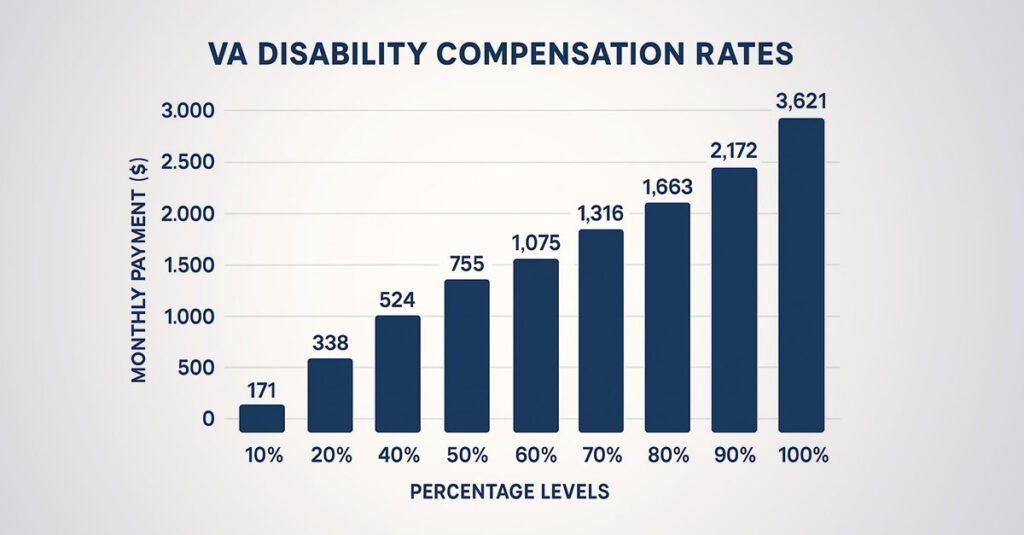
The VA’s rating system uses percentages from 0% to 100% in 10% increments, but the mathematics behind combined ratings often surprises veterans. Ratings don’t simply add together.
Instead, the VA uses a “whole person” concept. Each additional condition affects the remaining efficiency of an already impaired person. A veteran with a 50% rating has 50% efficiency remaining, so a second 30% condition affects that remaining 50%, not the whole person.
Understanding this system helps veterans understand which conditions to claim and how evidence is evaluated for rating determinations.
Combined Ratings Example:
| Individual Ratings | Simple Addition | Actual Combined Rating |
| 50% + 30% | 80% | 65% |
| 70% + 50% | 120% | 85% |
| 40% + 30% + 20% | 90% | 67% |
Individual Unemployability (TDIU) Considerations
When service-connected disabilities prevent substantially gainful employment, veterans may qualify for compensation at the 100% rate even with lower combined ratings.
TDIU recognizes that disability percentages don’t always reflect real-world employment limitations. A veteran with severe anxiety might have a 70% rating but be completely unable to maintain employment.
Schedular vs. Extra-schedular TDIU
Schedular TDIU has specific rating requirements: one condition at 60% or more, or a combined rating of 70% with at least one condition at 40%. These thresholds create a presumption of unemployability.
Extra-schedular TDIU considers unique circumstances that prevent employment despite lower ratings. This option requires demonstrating that a specific combination of disabilities creates unemployability that ratings don’t capture.
The key difference lies in the evidence required. Schedular TDIU focuses on meeting rating thresholds, while extra-schedular TDIU emphasizes functional limitations and employment barriers.
Combined Ratings Mathematics
The VA’s combined rating formula often results in lower percentages than simple addition would suggest. A 50% rating combined with a 30% rating equals 65%, not 80%.
This system reflects the concept that disabilities don’t affect a person additively. Each condition impacts the remaining capacity of an already impaired individual.
Understanding this mathematics helps set realistic expectations and guides understanding of how the VA calculates overall disability ratings.
Bilateral Factor Applications
Bilateral conditions affecting both sides of the body receive special consideration. The VA applies a bilateral factor that increases combined ratings.
This factor recognizes that having the same condition on both sides creates additional impairment beyond what individual ratings suggest. Bilateral hearing loss, for example, creates more significant limitations than the sum of individual ear ratings.
The bilateral factor applies before combining with other conditions, potentially pushing overall ratings into higher compensation brackets.
Pyramiding Rules and Limitations
The VA prohibits rating the same symptoms under multiple diagnostic codes—a concept called pyramiding. Veterans cannot receive separate ratings for the same manifestation of a condition.
However, veterans can receive separate ratings for different symptoms of the same condition. A back injury might rate separately for limited range of motion and muscle spasm if they represent distinct impairments.
Understanding pyramiding rules helps veterans present conditions appropriately, ensuring they receive credit for all distinct symptoms without violating VA regulations.

The VA Claims Process
Successfully navigating the VA claims process requires strategic preparation, proper timing, and comprehensive evidence development. Filing an Intent to File preserves an effective date for up to one year while gathering supporting documentation, potentially securing significant retroactive benefits. The Compensation & Pension examination often serves as a critical component of claims, requiring thorough preparation. When claims are denied or receive lower ratings than expected, the Appeals Modernization Act provides three distinct appeal pathways—supplemental claims for new evidence, higher-level reviews for identifying errors, and Board appeals with varying timelines and procedures.
Veterans should be aware that during recent government disruptions, VA benefits regional offices are closed during government shutdowns, though the VA estimates that 97 percent of its employees will continue to work and benefits processing will continue, which may affect claim submission timing and processing.
Evidence Development Strategies
Strategic preparation before submitting a claim can mean the difference between approval and denial, or between a 30% rating and a 70% rating. The VA processes millions of claims annually, and those with comprehensive evidence packages consistently achieve better outcomes.
Evidence development isn’t just about gathering medical records. Veterans build a compelling narrative that connects current limitations to military service. Every piece of documentation should support this central theme.
Timing claim submission strategically can affect both chances of approval and potential retroactive benefits.
Intent to File Benefits and Timing
According to the VA, filing an Intent to File (ITF) preserves an effective date for up to one year while evidence is gathered.
The financial impact can be substantial. A veteran with a 70% rating receives over $1,500 monthly. If gathering evidence takes six months, an ITF could secure an additional $9,000 in retroactive benefits.
ITF protection extends beyond initial claims. Veterans can file an ITF for increases to existing ratings, new conditions, or appeals.

Effective Date Considerations
An effective date determines when benefits begin, making it one of the most financially significant aspects of any claim. Understanding the rules helps veterans understand potential retroactive payments.
Generally, an effective date is either the date a claim was filed or the date a condition began, whichever is later. However, numerous exceptions can push effective dates earlier or later.
Claims filed within one year of discharge can have effective dates back to the day after separation. This rule recognizes that many veterans don’t immediately realize they have service-connected conditions.
Multiple Claim Coordination
When filing multiple conditions simultaneously, veterans should consider their relationships carefully. Some conditions work better as secondary claims to others already in the system.
The evidence requirements for each condition vary. Strong evidence for some conditions but weaker evidence for others may affect how claims are evaluated.
Compensation & Pension (C&P) Examination Information
The Compensation & Pension examination often determines rating outcomes more than any other single factor. The VA uses these examinations to evaluate the current severity of claimed conditions.
C&P examiners have limited time and specific protocols to follow. The examination captures the scope of disabilities within those constraints.
C&P examiners work for the VA and gather information for rating purposes. The VA uses these examinations as part of its evaluation process.
Examination Documentation
Veterans attending C&P examinations should bring comprehensive lists of symptoms, functional limitations, and examples of how conditions affect daily activities.
The VA rates disabilities based on their impact during flare-ups and bad periods, not during times when symptoms are well-managed.
Describing functional limitations provides valuable information. Instead of general statements, specific examples of how conditions affect work performance, relationships, and daily activities provide clearer pictures of disability impact.
Example: A veteran with PTSD might explain specific triggers like crowded spaces causing panic attacks that force them to leave grocery stores, sleep disturbances requiring medication changes every few months, and inability to concentrate at work leading to performance issues. Rather than simply stating “I have nightmares,” describing waking up 3-4 times nightly, sweating, and being unable to return to sleep provides more detailed information for the examiner.
Post-Examination Follow-up
Reviewing C&P examination reports carefully once they become available is important. Veterans should look for inaccuracies, omissions, or mischaracterizations of symptoms or limitations.
If reports contain significant errors or don’t adequately reflect a condition’s severity, veterans have options. Statements correcting inaccuracies can be submitted, or new examinations can be requested through appropriate VA channels.
Additional evidence submitted after C&P examinations can supplement examiner findings. Recent medical records, updated physician statements, or new test results can strengthen claims even after examinations are complete.
Appeals and Reviews
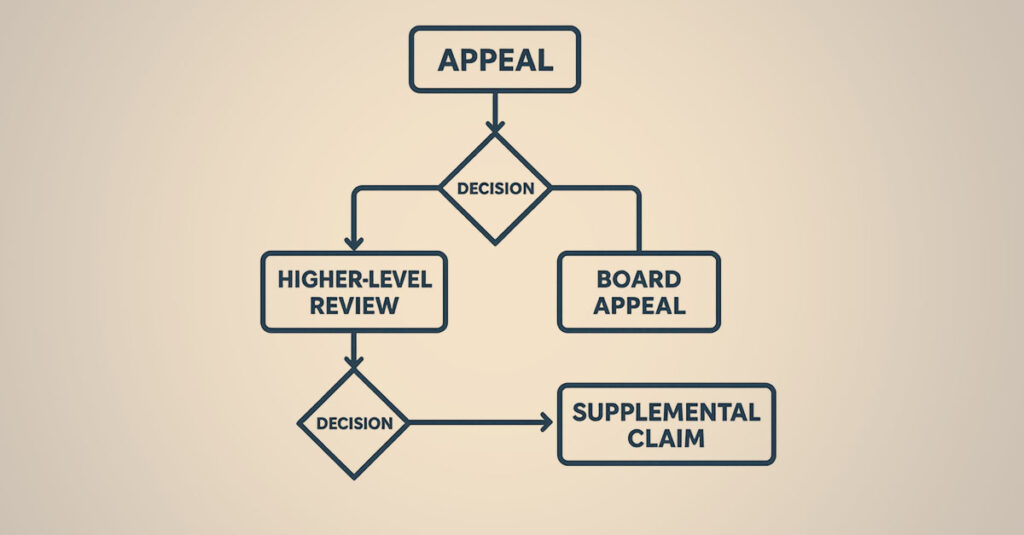
The Appeals Modernization Act revolutionized the VA appeals process, creating three distinct pathways with different advantages and timelines. Understanding these options helps veterans choose appropriate strategies for their specific situations.
Each appeal option has specific rules about evidence, timelines, and procedures. The one-year deadline for filing appeals is strict. Missing this deadline means veterans need to file new claims, potentially affecting original effective dates and retroactive benefits.
Appeal Options Comparison:
| Appeal Type | Timeline | New Evidence Allowed | Best For |
| Supplemental Claim | Fastest (varies) | Yes | Cases with new evidence |
| Higher-Level Review | Medium (varies) | No | Identifying decision errors |
| Board Appeal | Longest (varies) | Depends on docket | Complex legal issues |
Supplemental Claim Strategy
According to the VA, supplemental claims allow veterans to submit new and relevant evidence while maintaining appeal timelines. This option often provides faster resolution when veterans have additional supporting documentation.
The evidence must be both “new” (not previously submitted) and “relevant” (tends to prove or disprove the matter at issue). Meeting both criteria is essential for supplemental claim consideration.
New medical evidence, updated physician opinions, or recently discovered service records all qualify as new and relevant evidence. The key is ensuring the evidence addresses the specific reasons for unfavorable decisions.
New Evidence Requirements
Evidence qualifies as “new” if the VA hasn’t previously considered it in connection with claims. This includes evidence that existed before but wasn’t submitted, as well as evidence created after decisions.
“Relevant” evidence tends to prove or disprove a material fact in claims. Evidence about unrelated conditions or time periods typically doesn’t meet the relevance standard.
The combination of new and relevant creates a powerful tool for addressing unfavorable decisions. A single piece of compelling evidence can completely change claim outcomes.
Higher-Level Review Process
Higher-level reviews involve a senior VA employee examining cases and existing evidence without considering new evidence. The focus is identifying clear and unmistakable errors in original decisions.
This option works best when veterans believe the VA made an error in applying law or regulation to evidence, not when they need to submit additional evidence.
The higher-level review process is typically faster than Board appeals but more limited in scope than supplemental claims.
Decision Review Officer Considerations
Decision Review Officers (DROs) examine whether original decisions correctly applied VA law and regulations to the evidence of record. They look for errors in legal interpretation or factual findings.
DROs can identify errors that warrant different outcomes, such as misapplication of rating criteria, failure to consider all evidence, or incorrect effective date determinations.
The DRO’s fresh perspective sometimes catches errors that original decision-makers missed. However, they’re limited to the evidence that was available during original decisions.
Board of Veterans’ Appeals Options
The Board of Veterans’ Appeals offers three dockets with different timelines and evidence submission rules. Choices depend on case-specific circumstances and priorities regarding speed versus thoroughness.
Board appeals typically take longer than other options but provide comprehensive reviews. Veterans Law Judges have extensive experience with complex disability claims.
Understanding each docket’s advantages and limitations helps inform decisions about appeal strategies.
Direct Review Docket
The Direct Review docket is the fastest Board option, relying solely on existing evidence. This choice works well when evidence of record should support favorable decisions.
Veterans choosing this docket prioritize speed over the opportunity to submit additional evidence. The trade-off is accepting that the Board will decide based only on what’s already in files.
Direct Review works particularly well for legal issues, rating criteria disputes, or cases where evidence is strong but was misinterpreted by lower-level decision-makers.
Evidence Submission Docket
According to the VA, the Evidence Submission docket allows veterans to submit additional evidence while maintaining Board appeals. This option balances speed with the opportunity to strengthen cases.
Veterans have 90 days from docket selection to submit new evidence. This timeline provides opportunity to gather additional documentation.
This docket works well when veterans have some additional evidence to submit but don’t need the extensive development opportunities provided by the hearing docket.

The Benefits Package
Veterans disability benefits extend far beyond monthly compensation payments to include comprehensive support programs that can dramatically improve quality of life and financial security. Vocational Rehabilitation and Employment (VR&E) provides up to 48 months of education, training, and employment assistance through multiple specialized tracks. Additional benefits include dependent allowances for qualifying disability ratings, survivor benefits for families, and numerous state-specific programs offering property tax exemptions and other financial advantages. Understanding and accessing these supplementary benefits can add thousands of dollars in value to overall benefits packages while providing crucial support for career development and family security.
Employment challenges remain significant for veterans with disabilities. Only 25% of the 131,900 veterans with a service-connected rating of 70% or higher are employed, highlighting the critical importance of vocational rehabilitation and comprehensive benefits packages.
Additional Benefits and Special Programs
Most veterans focus exclusively on monthly disability compensation, missing out on thousands of dollars in additional benefits and services. These supplementary programs often provide more long-term value than monthly payments themselves.
The VA operates numerous benefit programs beyond disability compensation, each with specific eligibility requirements and application processes. Many veterans qualify for multiple programs simultaneously.
State and local governments also offer veteran-specific benefits that complement federal programs. These benefits vary significantly by location but can provide substantial financial advantages.
Vocational Rehabilitation and Employment (VR&E)
Chapter 31 benefits provide comprehensive support for veterans with service-connected disabilities who need assistance preparing for, finding, or maintaining employment. This program offers significantly more than basic job training.
VR&E covers tuition, fees, books, supplies, and provides monthly housing allowances during training periods. The program can last up to 48 months of full-time participation, potentially worth over $100,000 in total benefits.
Eligibility requires a service-connected disability rating of at least 10% and a determination that veterans need vocational rehabilitation to overcome employment barriers caused by service-connected conditions.
Employment Track Benefits
The employment track focuses on helping veterans develop skills and find suitable work in chosen fields. Services include job training, apprenticeships, on-the-job training, and direct job placement assistance.
Monthly subsistence allowances during training periods help cover living expenses while veterans develop new skills. These payments are separate from disability compensation and don’t affect ratings.
The program provides comprehensive support including career counseling, resume development, interview preparation, and job search assistance. Case managers work with veterans throughout the entire process.
Independent Living Track Options
Veterans whose disabilities prevent competitive employment can access independent living services designed to help achieve maximum independence in daily activities.
This track provides assistive technology, home modifications, training in adaptive techniques, and other services that improve quality of life and functional independence.
Independent living services recognize that not all veterans can return to traditional employment but deserve support in achieving their maximum potential for independent functioning.
Rapid Access to Employment Track
The streamlined Rapid Access to Employment track serves veterans who need minimal intervention to secure and maintain employment in their existing fields of expertise.
This track provides up to 12 months of focused services such as job search assistance, interview skills training, workplace accommodations, and short-term training to update skills.
Veterans in this track typically have recent work experience and transferable skills but need specific support overcoming disability-related employment barriers.

Dependent and Survivor Benefits
Veterans with disability ratings of 30% or higher can claim additional compensation for dependents, including spouses, children, and dependent parents. These payments add hundreds of dollars monthly to compensation.
Dependent benefits increase with disability rating percentages. A veteran with a 50% rating receives more for dependents than one with a 30% rating.
Understanding dependent benefits helps veterans understand their family’s financial security and ensures they’re receiving all compensation available through their service.
Dependency and Indemnity Compensation (DIC)
Surviving spouses and children of veterans who died from service-connected conditions or were rated totally disabled for 10 or more years may qualify for monthly DIC payments.
DIC provides ongoing financial support for military families who’ve lost their veteran to service-connected causes. The benefit recognizes the ultimate sacrifice and provides dignity for surviving family members.
Recent legislative changes have expanded DIC eligibility and increased payment amounts, reflecting Congress’s recognition of the program’s importance for military families.
State-Specific Veteran Benefits
Individual states offer numerous benefits that complement federal veterans affairs benefits. These benefits vary dramatically by state, making choice of residence financially significant.
Some states provide comprehensive veteran benefit packages worth thousands of dollars annually, while others offer minimal additional support. Researching state benefits can inform relocation decisions.
State benefits often include property tax exemptions, vehicle registration discounts, hunting and fishing license waivers, and state-funded education programs for veterans and their families.
Example: A 100% disabled veteran in Texas receives complete property tax exemption on their homestead, potentially saving $8,000-$15,000 annually. The same veteran in a state without property tax benefits would pay full taxes, making Texas residence worth tens of thousands of dollars over time. Additionally, Texas offers free hunting and fishing licenses, reduced vehicle registration fees, and state-funded college tuition assistance for dependents.

Property Tax Relief Programs
States like Texas, Florida, and California offer significant property tax exemptions for disabled veterans. These exemptions can save thousands of dollars annually based on disability rating percentages.
Texas provides complete property tax exemption for veterans with 100% disability ratings, potentially saving $5,000-$15,000 annually depending on property values and local tax rates.
Some states extend property tax benefits to surviving spouses, ensuring continued financial relief for military families even after the veteran’s death.

Specialized Medical Conditions
Complex medical conditions require specialized understanding of VA rating criteria and unique documentation strategies. Mental health conditions, particularly PTSD, have specific evidence requirements and benefit from recent policy changes that have made these claims more accessible. Sleep disorders like sleep apnea increasingly connect to other service-connected conditions and require strategic approaches, especially given recent changes requiring CPAP compliance for higher ratings. Understanding these nuanced areas helps veterans navigate specialized claim types that often involve complex medical relationships and evolving VA policies.
Complex Medical Conditions and Rating Nuances
Certain conditions require deep understanding of VA rating schedules, medical terminology, and specialized documentation approaches. These complex claims often determine the difference between minimal compensation and life-changing benefits.
The VA’s rating schedules contain intricate criteria that aren’t always intuitive. Understanding these nuances helps veterans present evidence in ways that align with rating requirements.
Medical conditions don’t exist in isolation. The VA’s approach to rating complex conditions considers functional limitations, treatment requirements, and impact on daily activities.
Mental Health Conditions and PTSD Claims
Mental health claims face unique challenges in the VA system, but recent policy changes have made these claims significantly more accessible for veterans who previously struggled to establish service connection.
PTSD claims require establishing both the traumatic stressor event and the current diagnosis. The evidence requirements vary significantly based on the type of stressor and military occupation.
Combat veterans receive more favorable evidence standards, while non-combat veterans face higher documentation requirements. Understanding these differences helps veterans understand appropriate evidence packages.
Stressor Event Documentation for PTSD
Combat veterans can rely on lay testimony for stressor events, recognizing that official documentation of combat incidents often doesn’t exist or isn’t accessible to individual veterans.
Non-combat veterans typically need corroborating evidence of stressor events, though military sexual trauma cases have relaxed evidence requirements under recent VA policy updates.
The VA has established specialized procedures for military sexual trauma claims, recognizing the barriers survivors face in reporting incidents and the often limited official documentation.
Functional Impairment in Mental Health Claims
While the VA no longer officially uses Global Assessment of Functioning (GAF) scores in rating decisions, understanding how mental health symptoms translate to functional impairment ratings remains crucial for claim success.
Mental health ratings focus on occupational and social impairment rather than specific symptoms. Describing functional limitations carries more weight than listing diagnostic criteria.
The key lies in articulating how mental health conditions affect work performance, relationships, and daily activities. Specific examples resonate more than general statements about symptoms.
Sleep Disorders and Secondary Conditions
Sleep apnea and other sleep disorders represent increasingly common claims that often connect to other service-connected conditions. These claims require understanding of both medical relationships and rating criteria evolution.
Sleep disorders frequently develop secondary to other conditions like PTSD, depression, or physical injuries that affect sleep positioning. Establishing these connections can significantly increase overall disability ratings.
The VA has modified sleep apnea rating criteria in recent years, making compliance with treatment requirements more important for maintaining higher ratings.
Sleep Apnea Rating Criteria Evolution
Recent changes require continuous positive airway pressure (CPAP) machine compliance for higher sleep apnea ratings. Documentation of usage patterns has become critical for maintaining benefits.
Veterans must demonstrate consistent CPAP use to qualify for higher rating percentages. The VA now reviews compliance data from CPAP machines to verify treatment adherence.
This change reflects the VA’s emphasis on treatment compliance and functional improvement rather than simply having a diagnosis. Veterans who don’t use prescribed treatments may receive lower ratings.
How REE Medical Supports Veterans
Understanding the complexity of veterans disability benefits highlights why veterans navigating the VA system may find it helpful to have comprehensive, objective medical documentation available as part of their evidence.
REE Medical coordinates independent medical evaluations and Disability Benefits Questionnaires (DBQs) prepared by licensed medical professionals. These objective clinical documents follow VA-standardized formats and may be reviewed by the VA as part of its independent evaluation process. REE Medical does not prepare, present, or submit VA disability claims and does not make VA benefit decisions.
The VA uses DBQs and independent medical evaluations as part of its evidence review process. Clear, comprehensive medical documentation allows the VA to assess the full scope of veterans’ conditions.
Independent Medical Documentation
REE Medical connects veterans with independent, licensed healthcare professionals who complete DBQs and medical evaluations. These providers are familiar with disability-focused documentation and VA-standardized forms; REE Medical’s own staff do not provide medical care, legal advice, or claims representation.
The documentation process focuses on accuracy, thoroughness, and clarity. Comprehensive medical evidence allows the VA to understand diagnoses, symptoms, treatment history, and functional limitations.
Veterans can access complimentary consultations to learn about how independent medical documentation is coordinated and how it may be used within the VA’s evaluation process. These consultations are informational only and are not legal, medical, or claims advice.
The DBQ Documentation Process
Disability Benefits Questionnaires are standardized VA forms that medical professionals use to document specific conditions. These forms were designed by the VA to capture the medical information relevant to disability ratings.
Independent medical evaluations completed through REE Medical follow these VA-standardized formats. The documentation is objective and clinically focused, describing conditions as they exist at the time of examination.
Licensed medical professionals who complete these evaluations are independent practitioners, not VA employees. The evaluations provide objective clinical information that the VA can review as part of the evidence in a veteran’s file.
Informational Resources
REE Medical provides general informational information about how VA evaluations work and the role of medical evidence. Veterans can learn, at an informational level, about the types of documentation the VA may review when making rating determinations; this information is not a substitute for legal, medical, or accredited representative advice.
Understanding the VA’s evaluation process helps veterans appreciate why clear documentation matters. The VA bases its decisions on the evidence in each veteran’s file, including service treatment records, VA examinations, private medical records, and any other relevant medical documentation.
Informational resources explain how DBQs fit within the VA process as a form of objective medical reporting. Veterans learn about the types of information medical professionals document and how the VA uses this information.
Consultation Services
REE Medical offers complimentary consultations to explain how independent medical documentation is coordinated. These consultations are informational and help veterans understand the documentation process.
During consultations, general information may be shared regarding:
- The purpose of independent medical evaluations
- The types of information medical professionals may document
- The general structure of VA Disability Benefits Questionnaires (DBQs)
- The role of objective medical evidence as considered in the VA’s evaluation process
- The involvement of licensed medical providers in independent evaluations
Consultations focus on education rather than claims advice. REE Medical does not prepare, present, or submit VA disability claims and does not provide legal or representational services.

Frequently Asked Questions
What documentation does the VA review when evaluating disability claims?
According to the VA, disability rating decisions are based on all evidence in a veteran’s file, including service treatment records, VA medical examinations, private medical records, DBQs, lay statements, and other relevant documentation.
How does the VA determine effective dates for benefits?
Per VA guidance, effective dates are generally the date a complete claim was received or the date entitlement arose, whichever is later. Specific rules apply to different claim types, including special provisions for claims filed within one year of discharge.
What are the different appeal options available?
According to the VA, veterans who disagree with decisions may request a Supplemental Claim (when new and relevant evidence is available), a Higher-Level Review (for identifying decision errors), or a Board Appeal (with options for direct review, evidence submission, or hearing).
How long does the VA take to process claims?
Per VA data, processing times vary based on claim complexity, evidence availability, and current workload. The VA provides estimated processing times on its website for different claim types and regional offices.
What is Individual Unemployability (TDIU)?
According to the VA, TDIU provides compensation at the 100% rate for veterans whose service-connected disabilities prevent substantially gainful employment, even when combined ratings are less than 100%.
Are there benefits available beyond monthly compensation?
Per VA guidance, eligible veterans can access Vocational Rehabilitation and Employment benefits, dependent allowances, survivor benefits, healthcare, and various other programs based on their disability ratings and circumstances.
How are secondary conditions evaluated?
According to the VA, secondary service connection is established when evidence shows that a current disability was caused or aggravated by an already service-connected condition. Independent medical evaluations must establish the causal relationship.
What is the PACT Act?
Per recent legislation, the PACT Act of 2022 expanded presumptive conditions for toxic exposure, including burn pit exposure, Agent Orange, and other environmental hazards. The Act affects veterans who served in specified locations during certain time periods.
Final Thoughts
Veterans disability benefits represent more than monthly compensation—they’re recognition of sacrifice and a foundation for rebuilding civilian life after military service. The system’s complexity can feel overwhelming, but understanding the key principles outlined here helps veterans navigate the process.
Success in the VA system requires patience, preparation, and persistence. Every piece of evidence matters, every deadline has consequences, and every decision affects financial futures. Veterans who achieve the best outcomes approach their claims strategically, understanding that this process is as important as any mission they completed in uniform.
Military service earned these benefits. The VA system, despite its challenges, exists to honor that service through concrete support for the challenges veterans face because of their military experience. Veterans deserve access to the benefits and support they earned through their dedication to our country.
REE Medical remains committed to supporting veterans by coordinating independent, objective medical documentation that may be submitted as part of a veteran’s evidence for the VA to review when it evaluates service-connected conditions.
Learn more about how REE Medical coordinates independent medical evaluations and DBQ documentation that may be submitted to the VA as part of a disability claim file at www.reemedical.com.
DISCLAIMER: REE Medical, LLC is not a Veterans Service Organization (VSO) or a law firm and is not affiliated with the U.S. Veterans Administration (“VA”). Results are not guaranteed, and REE Medical, LLC makes no promises. REE Medical’s staff does not provide medical advice or legal advice, and REE Medical is not a law firm. Any information discussed, such as, but not limited to, the likely chance of an increase or service connection, estimated benefit amounts, and potential new ratings, is solely based on past client generalizations and not specific to any one patient. The doctor has the right to reject and/or refuse to complete a Veteran’s Disability Benefit Questionnaire if they feel the Veteran is not being truthful. The Veteran’s Administration is the only agency that can make a determination regarding whether or not a Veteran will receive an increase in their service-connected disabilities or make a decision on whether or not a disability will be considered service-connected. This business is not sponsored by, or affiliated with, the United States Department of Veterans Affairs, any State Department of Military and Veterans Affairs, or any other federally chartered veterans service organization.